

 EN
EN RU
RU

 Home/Blogs/Industry Knowledge/What Is a Power Transformer? Its Role in Modern Grid Transmission and the AI Era
 April 10, 2026
A power transformer is the cornerstone of high-efficiency operation in modern electrical grids. Operating on the principle of electromagnetic induction, its fundamental role is to precisely regulate AC voltage levels while maintaining a constant frequency, ensuring the reliable long-distance transmission and terminal distribution of electricity across complex networks. To meet diverse power demands, various types of power transformers work in synergy to bridge the gap between energy production and terminal consumption, serving as the essential infrastructure supporting modern industry and the burgeoning AI computing era.
What Is a Power Transformer?
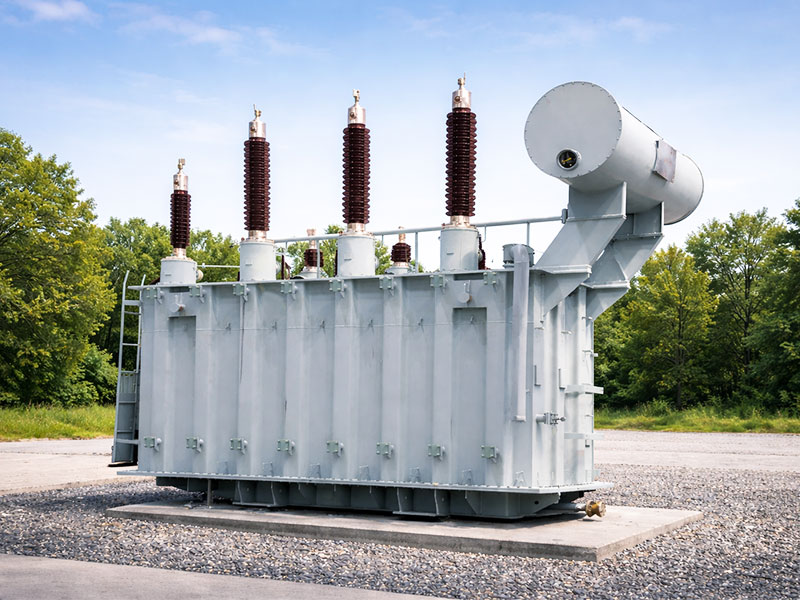
A power transformer is a static induction device based on the principle of electromagnetic induction. Its primary function is to step up or step down AC voltage levels while maintaining a constant grid frequency. Within modern power infrastructure, these devices primarily serve transmission networks and large-scale industrial distribution tiers, elevating raw voltage from power stations for long-distance transmission or reducing high voltage at regional substations and load centers for further distribution and use.
Unlike small distribution transformers used for end-user service, power transformers typically feature higher technical specifications and broader capacity coverage. In practical applications, their voltage ratings span from medium-high levels like 33kV and 35kV to extra-high-voltage (EHV) ranges of 110kV, 220kV, or even higher. Their rated capacities vary significantly, covering various specifications from several hundred kVA (such as the common 800kVA) to hundreds of MVA (such as 31.5MVA or more). These high voltage power transformers are engineered to handle massive power loads and maintain exceptional energy conversion efficiency under continuous high-voltage operation.
The existence of power transformers addresses the mismatch between energy output and terminal consumption in terms of both voltage levels and geographic distance. By performing precise voltage conversion, transformers not only significantly reduce energy loss during long-distance transmission but also ensure that various facilities at the edge of the grid—such as large industrial bases and modern AI data centers—receive a stable and compliant power supply. This optimization of transmission efficiency and system compatibility makes them an indispensable pillar of modern power supply systems.
Power Transformer Working Principle
The operation of a power transformer is essentially a chain reaction of energy states centered on Faraday’s Law of Induction. It utilizes an alternating magnetic field as a medium to instantaneously convert input electrical energy into dynamic magnetic energy, which is then re-induced into output electrical energy at a specific voltage. This dynamic process occurs in three main stages:
Excitation: From Electricity to Magnetic Energy
When the primary winding of a transformer is connected to an AC power source, the alternating current flowing through it immediately excites a synchronously varying magnetic flux within the iron core. Due to the core’s high magnetic permeability, these magnetic fields are confined within specific paths, forming a closed and constantly fluctuating loop of magnetic flux lines.
Coupling: Cross-System Flux Transmission
Acting as the magnetic medium, the iron core efficiently guides the dynamic flux generated on the primary side to pass through the secondary winding. This physical magnetic link allows two electrically isolated circuit systems to achieve tight energy coupling through shared magnetic field variations, laying the foundation for the regeneration of electricity.
Transformation: Induced Voltage Regulation
As the secondary winding senses the varying magnetic flux passing through it, an induced electromotive force (EMF) is generated according to the laws of electromagnetic induction. At this stage, electrical energy is extracted back from the magnetic field. The output voltage level depends entirely on the turns ratio between the two windings:
- Step-up Logic: Increasing the number of turns in the secondary winding stacks the induced potential, resulting in a higher output voltage.
- Step-down Logic: Conversely, decreasing the number of turns in the secondary winding reduces the output voltage level accordingly.
This mechanism, based on dynamic magnetic field changes, ensures that the current frequency remains perfectly consistent with the input throughout the transfer, achieving efficient power regulation.
Power Transformer Components and Construction
The physical construction of a power transformer provides the foundation for electromagnetic induction and ensures long-term operational safety. With no moving parts, energy transfer relies entirely on the electromagnetic coupling between the electrical and magnetic systems. To maintain the stability and efficiency of this coupling across various environments, power transformers are built with a rigorous physical architecture.
Fundamental Structural Power Transformer Components
Regardless of the type, every power transformer incorporates basic physical systems that support electromagnetic energy conversion:
- Magnetic Circuit System: Centered on the iron core, usually constructed from laminated silicon steel sheets with high magnetic permeability. It provides a closed path for the magnetic flux, serving as the physical medium for energy exchange.
- Electrical Circuit System: Comprised of high-voltage and low-voltage windings, typically made of copper or aluminum conductors. These windings facilitate the input and output of electricity across different voltage levels through the influence of the alternating magnetic field.
Power Transformer Construction Design Based on Cooling Media
Power transformers generate heat as a byproduct of energy loss during operation, requiring efficient heat dissipation and insulation solutions. Subject to the cooling medium used, the primary structure varies significantly:
1. Oil-Immersed Power Transformers
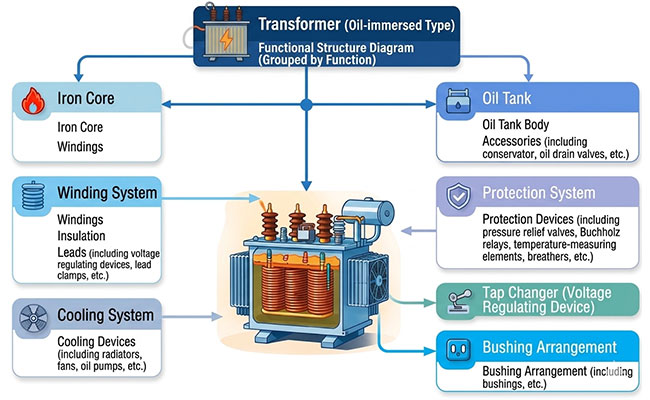
Oil-immersed power transformers use insulating oil as the primary medium for both insulation and cooling. To ensure the physical performance and safety of the oil, the structure is relatively sophisticated, including several specialized protective and cooling components:
- Oil Tank: Serves as the sealed main housing for the core and windings. It is filled with insulating oil, providing mechanical support, heat dissipation, sealing, and electrical insulation.
- Conservator (Oil Expansion Tank): Mounted above the tank to compensate for the expansion and contraction of the oil due to temperature changes, ensuring the tank remains full and minimizing the oil’s contact with air.
- Cooling System: Consists of radiators or cooling tubes that dissipate internal heat to the environment through natural convection or forced circulation of the oil.
- Protective Devices: A typical example is the Buchholz relay, installed in the piping between the tank and the conservator to monitor internal faults and trigger alarms or disconnect power in case of abnormalities.
2. Dry-Type Power Transformers
Dry-type transformers do not use liquid insulation; instead, they rely on air or specialized resin for insulation and heat dissipation, resulting in a more compact and fire-resistant structure:
- Resin-Cast Windings: The windings are encapsulated in epoxy resin, providing high mechanical strength, excellent moisture resistance, and self-extinguishing flame-retardant properties.
- Support Frame: Utilizes high-strength clamps and tie rods to ensure the core and windings remain stable even under significant electromagnetic stress.
Critical Auxiliary Devices
Beyond the core magnetic and electrical systems, several devices are essential for regulation performance and grid safety:
- Tap Changer: Functions as a voltage regulation control device. By altering the effective number of turns in the winding, it adjusts the output voltage—either while energized (on-load) or de-energized (off-circuit)—to compensate for grid voltage fluctuations.
- Insulating Bushings: Responsible for leading the internal winding connections through the external casing while providing critical electrical insulation and mechanical support, ensuring high-voltage current is safely and stably integrated into the grid. Advanced solutions such as RIP bushings are increasingly utilized in high-voltage applications due to their superior thermal stability, fire resistance, and maintenance-free design.
Different Types of Power Transformers
Influenced by variations in voltage levels, installation environments, and load characteristics, power transformers come in diverse structural designs and insulation media to ensure optimal performance for specific operational conditions. Consequently, a wide range of specifications and types are available on the market.
1. Classification by Application and Grid Position
Transformers are installed at various stages of the grid, each performing distinct tasks. Based on their purpose and location, they are generally categorized as follows:
- Step-Up Transformers: Primarily installed at power plants. Since high-voltage transmission significantly reduces energy loss, these transformers elevate the voltage generated by turbines to extra-high levels for long-distance transport.
- Substation Transformers: Serving as the grid’s operational hubs, these are deployed in various primary substations. They reduce high-voltage power to medium levels, acting as a critical link between the transmission grid and the regional distribution network.
- Distribution Transformers: Located at the terminal end of the supply system, they convert medium-voltage power into low-voltage electricity for direct end-user consumption. They typically have smaller capacities and are widely distributed in industrial zones, commercial centers, and residential communities.
- Step-Down/Special Purpose Transformers: Widely used in specific industrial scenarios, such as power distribution within factories or for rectifiers, electric furnaces, and other specialized processes requiring precise voltage levels for equipment operation.
2. Classification by Cooling Method and Insulation Medium
Based on safety, heat dissipation efficiency, and maintenance requirements, two primary insulation solutions are utilized:
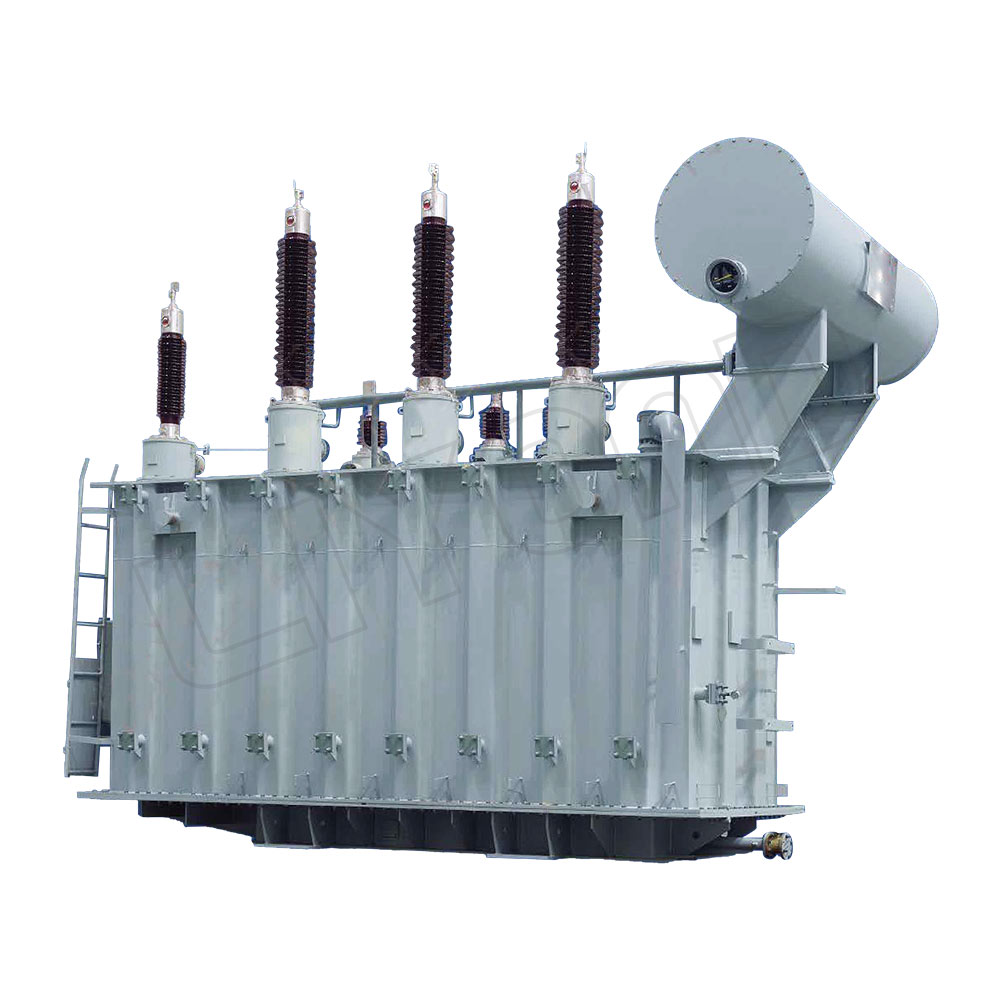
- Oil-Immersed Transformers: Components are submerged in insulating oil for heat dissipation. Known for their exceptional reliability and overload capacity, they are the mainstream choice for large outdoor substations and high-voltage grids.
- Dry-Type Transformers: Utilize air or epoxy resin casting as the insulating medium. By eliminating oil leakage and fire hazards, these are the preferred choice for indoor or high-security environments like shopping malls, subway stations, and high-rise buildings.

3. Classification by Phase
- Single-Phase Transformers: Primarily used for specific low-voltage distribution, power coverage in remote areas, or as dedicated power supplies for precision instruments.
- Three-Phase Transformers: The standard configuration for modern power systems. Their structure is more compact than a group of three single-phase transformers, enabling higher efficiency for large-scale energy transmission.
4. Classification by Winding Structure
- Two-Winding Transformers: Feature a standard structure with independent primary and secondary windings, where the two circuits are electrically isolated and energy is transferred via magnetic coupling.
- Autotransformers: Share part of the winding between the primary and secondary sides. These offer advantages in size, material savings, and high efficiency, often used for interconnecting grid nodes with similar voltage levels.
Power Transformer Applications
As indispensable nodes in the grid architecture, the application of power transformers is rooted in the long-distance transmission and terminal distribution of energy. Whether supporting regional power transfer in national backbone grids or ensuring the steady operation of industrial parks and commercial facilities, power transformers play a pivotal role.
1. Power Transformers in Utilities and Grid Transmission & Distribution
In the utility sector, transformers are primarily responsible for the efficient conversion of electricity between different voltage levels, ensuring grid operational efficiency and power quality.
- High-Voltage Transmission Hubs: Step-up transformers are deployed at the generation side to reduce current density by elevating voltage, thereby significantly minimizing thermal losses during long-distance transmission.
- Substation Load Dispatching: Hub substations utilize large-capacity power transformers to step down high-voltage power to medium levels, facilitating power distribution and regulation based on regional load demand.
- Terminal Distribution: Distribution transformers convert medium-voltage power into low-voltage standards compliant with end-user requirements, ensuring final access and stable supply for residential and commercial facilities.
2. Power Transformers in Industrial Manufacturing and Mining
Heavy industry and mining require extreme durability from transformers. Equipment must not only carry heavy electrical loads but also physically withstand harsh operational environments. Therefore, applications in this field focus on reliability and impact resistance.
- Mining Energy Security: In mining environments, transformers provide stable power for hoisting equipment, ventilation systems, and crushers. Their designs are typically reinforced to resist dust, humidity, and mechanical vibration.
- Industrial Load Support: In steel, metallurgy, and petrochemical sectors, transformers handle surge loads from electric furnaces or large motor startups, ensuring production line voltage stability and effectively preventing production losses due to downtime.
3. Power Transformers in Renewable Energy Integration
As the global energy landscape shifts toward a green, low-carbon future, transformers have become critical interfaces for connecting clean energy to the main grid. Since wind and solar energy are highly intermittent and decentralized, this presents new challenges for grid flexibility and voltage stability.
- Renewable Step-Up Integration: In solar farms or wind farms, transformers integrate and elevate power from individual generation units, ensuring that frequency, phase, and voltage metrics meet grid connection standards.
- Energy Storage Coupling: Transformers play a key role in the charging and discharging cycles of energy storage stations, ensuring electricity flows efficiently and adaptively between battery banks and the grid.
4. Power Transformers in Commercial Infrastructure and Urban Transport
Urban infrastructure projects favor transformers based on space efficiency and public safety. In densely populated urban areas, fire performance and supply reliability are core performance indicators.
- Data Center Protection: Meeting the precision power needs of data centers, transformers support 24/7 server cluster operation by providing high-quality “clean” power and maintaining efficient heat dissipation.
- Rail Transit Power: Subway and high-speed rail systems rely on transformers for traction power. Such units must possess strong instantaneous overload capabilities to handle power demand peaks during vehicle startup or acceleration.
- Public Building Distribution: To ensure safety in crowded venues, dry-type transformers are often selected for high-rise buildings. Their non-flammable characteristics not only reduce indoor fire risks but also significantly optimize installation space within equipment rooms.
Driving Forces: The Growing Demand for Power Transformers in the AI Era
With their vast range of applications, power transformers have become a fundamental pillar supporting modern industry and society. Driven by new infrastructure construction, particularly the rapid advancement of Artificial Intelligence (AI) technologies, global demand for power transformers is experiencing explosive growth. The expansion of the AI industry is not limited to software; the heavy reliance of computing hardware on electrical supply makes power transformers more critical than ever as energy transmission hubs.
1. Reshaping Energy Density for Compute Centers
AI model training and inference processes have a rigid and high demand for electricity. To support the stable operation of ultra-large-scale compute clusters, data centers are expanding rapidly worldwide. Their individual power loads far exceed those of traditional commercial buildings, requiring distribution systems with greater power-carrying capacity. This leap in energy density is directly driving the large-scale deployment of high-performance power transformers at the distribution end of data centers.
2. Dual Challenges of Grid Stability and Power Quality
The continuous operational nature of the AI industry demands nearly impeccable power quality, as even minor voltage fluctuations can interrupt computing tasks. In this context, power transformers featuring higher reliability, robust anti-interference capabilities, and integrated digital monitoring are becoming standard configurations for intelligent infrastructure. This represents not just a growth in hardware demand, but a comprehensive technical upgrade in operational precision and stability.
3. Convergence of Energy Transition and Intelligent Trends
In the AI era, compute centers are actively integrating decentralized solar and wind energy to achieve sustainability. This further boosts demand for specialized transformers adapted for renewable energy integration. Simultaneously, transformers with low-loss characteristics and intelligent management functions assist operators in optimizing energy efficiency while meeting surging compute demands, effectively controlling overall operational costs.
Conclusion
From supporting cross-regional transmission in backbone grids to empowering the computing foundations of the AI era, the role of the power transformer has evolved from a traditional voltage conversion device into a critical energy hub supporting the intelligent transformation of human society. Facing increasingly complex application scenarios and rising technical standards, the research, development, and manufacturing of transformers will continue to evolve toward higher efficiency, longevity, and environmental adaptability.
As a professional power transformer manufacturer in the electrical equipment field, Liyond is dedicated to providing solid safeguards for global power infrastructure through superior technical solutions. In a future where energy and intelligence are deeply integrated, we will continue to help customers address diverse power challenges, jointly driving a more efficient, reliable, and sustainable electrical world.
Get A Free Quote


Power your projects with long-lasting switchgear and switchgear components from Liyond.
