

 EN
EN RU
RU


June 30, 2026
According to the International Energy Agency’s (IEA) 2026 Global Energy Review, global electricity demand is undergoing a profound structural paradigm shift. Data reveals that electricity demand growth is significantly outpacing that of overall energy demand—rising by approximately 3% in 2025, while total global energy demand grew by only 1.3%. This “decoupling” phenomenon clearly signals that society is rapidly accelerating into the “Age of Electricity.”
This growth is no longer a linear trend but the result of multiple converging drivers. For power infrastructure, this means that legacy models based on historical data are becoming obsolete, leaving the grid to navigate an increasingly complex and high-intensity operating environment.
What’s Driving Surging Electricity Demand?
The current surge in power load stems not from any single isolated factor, but from the convergence of multiple forces.:
- Pressure from Hyperscale Digital Infrastructure: The explosion of AI and big data has transformed data centers into a primary engine of load growth. The non-negotiable “zero-downtime” requirements of these facilities have disrupted traditional grid design norms that relied on seasonal load curves, forcing distribution systems to operate at permanent base-load levels.
- Deepening Electrification in Industry and Transport: IEA reports indicate that the building and transportation sectors were the primary demand drivers in 2025. The rapid proliferation of electric vehicles (EVs) and the transition to industrial heating electrification have exerted unprecedented pressure on regional grids, creating numerous unforeseen load “blind spots.”
- Disorderly Integration of Distributed Energy Resources (DERs): The rapid expansion of renewable capacity requires the grid to manage not only supply-side fluctuations but also the complexities of reverse power flow from distributed sources. This introduces significant technical challenges for power flow control in transmission and distribution systems.
- The Societal Mandate for “Zero-Downtime”: In a highly digitized era, user tolerance for power outages has reached an all-time low. This societal mandate for uninterrupted power forces grid infrastructure to operate under high-intensity stress for extended periods, leaving virtually no margin for error.
These converging forces have pushed the grid to its operational limits. Systemic challenges—including key equipment operating in high-thermal-stress zones, expanding dispatch blind spots, and shrinking reliability boundaries—are now the norm. Relying solely on “extensive expansion” can no longer resolve these structural contradictions.
How Should the Grid Adapt to Rising Demand?
Facing these systemic challenges, traditional extensive expansion solutions fail to address the fundamental supply-demand tension. The grid’s upgrade path requires a synchronized evolution: macro-level planning paradigms must align with micro-level asset reliability management. This means lowering system uncertainty through scientific planning while building a robust supply system capable of withstanding high-stress operating conditions by reinforcing foundational electrical infrastructure resilience.
Shifting the Planning Paradigm: From Redundancy to Probabilistic Planning
Traditional grid planning has often relied on “defensive over-design”—building redundant capacity to hedge against uncertainty. However, as emphasized by the IEEE Power & Energy Society (PES), this model is unsustainable given rising construction costs and constrained budgets. The industry consensus is shifting toward flexible “probabilistic planning”: utilizing refined data analysis models—such as load uncertainty modeling—to dynamically evaluate growth. This ensures system security while precisely matching actual demand for the next 10–15 years, achieving the optimal balance between economic viability and reliability.
Fortifying Asset Resilience: Enhancing Hardware Reliability under Pressure
Under sustained high-load pressure, reinforcing the resilience of foundational assets is critical. The effectiveness of this strategy depends directly on the physical load-bearing capacity of the hardware. In environments defined by intense thermal and mechanical stress, the long-term reliability of power distribution equipment depends on the quality of every core component.
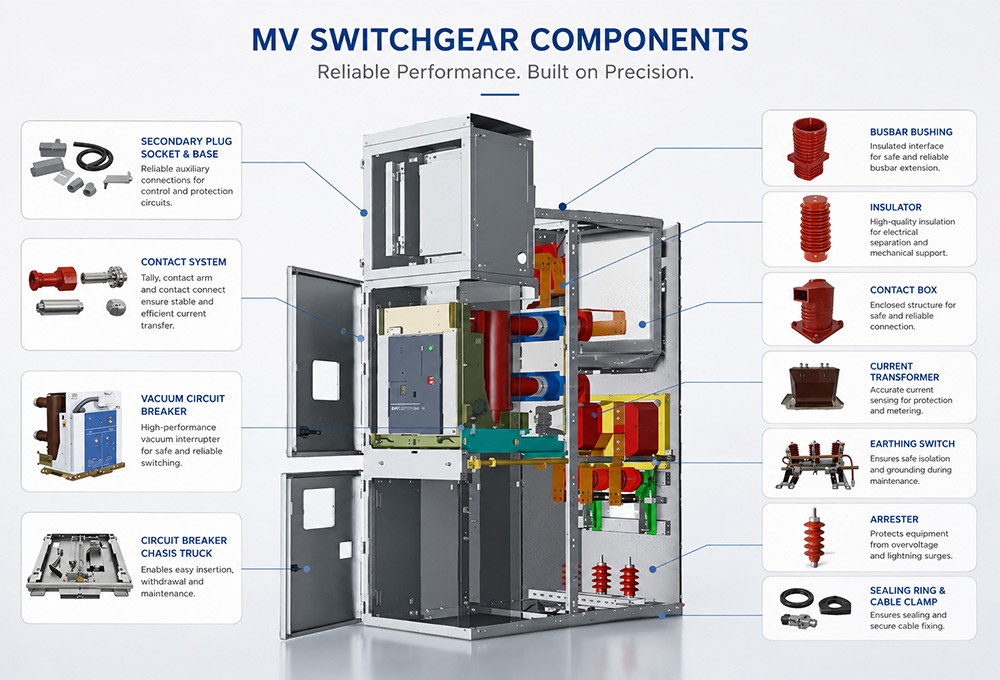
Switchgear acts as the heartbeat of the distribution chain. Its reliability hinges not only on system architecture but also on the performance of each internal key component. Focusing on these internals is a prerequisite for stability under stress. For example, the breaking performance and mechanical longevity of vacuum circuit breakers, the insulation stability of contact boxes and wall through bushings, the anti-tracking and mechanical strength of epoxy insulators, and the wear resistance of conductive contacts form the “first line of defense.” In high-load scenarios, these qualities determine an asset’s full life-cycle performance. Furthermore, the integration of critical technologies like auto recloser allows for millisecond-level response and restoration during transient faults, building an “active defense” against sudden disturbances. Together, these hardware standards and control technologies form the solid physical foundation for achieving “zero downtime.”
Future Perspectives: Establishing Dynamic Mechanisms Amid Volatility
Future grid resilience is no longer defined by static defense but by dynamic management. Grid managers must utilize intelligent monitoring to perform full life-cycle health assessments of key equipment, shifting from reactive repairs to predictive maintenance. Through these dynamic mechanisms, the grid can respond to load fluctuations in real-time, optimizing asset lifespan while ensuring uninterrupted service.
Strategy and Execution: Building Comprehensive Synergy
The surge in electricity demand is a permanent feature of the energy infrastructure transformation, not merely a temporary trend. Looking ahead, grid stability will not depend on one-dimensional capacity expansion; it will rely on a deep synergy between the flexibility of top-level planning and the reliability of micro-level foundational assets.
Facing this rapid growth, re-engineering the grid requires more than simple expansion—it demands a strategic alignment between macro-level decision-making and micro-level hardware management. Engineering leaders must drive the adoption of probabilistic planning while maintaining strict oversight of asset reliability, beginning with the selection of the most robust components. This strategy, bridging high-level planning with a solid physical foundation, will not only alleviate current operational pressures but also build the resilient base required for global networks to achieve their “zero-downtime” goals.
Get A Free Quote


Power your projects with long-lasting switchgear and switchgear components from Liyond.
