

 EN
EN RU
RU

 Home/Blogs/Industry Knowledge/Applications of Vacuum Circuit Breaker: Core Protection Solutions for MV to HV Power Systems
 March 20, 2026
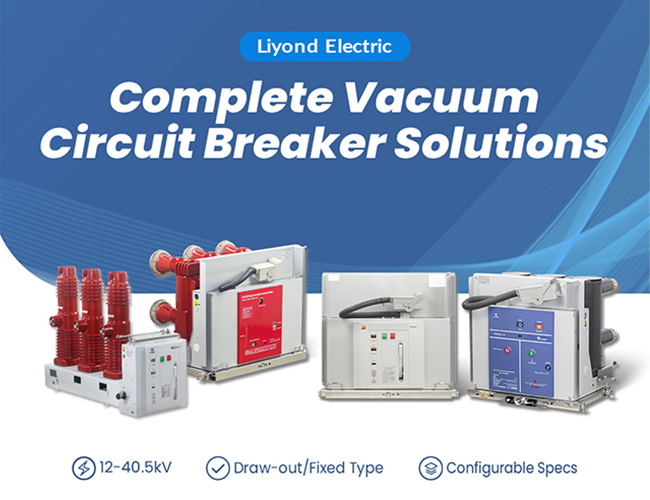
In modern electrical infrastructure, Vacuum Circuit Breakers (VCBs) have emerged as an indispensable protection hub, spanning from medium-voltage distribution networks to intensive industrial power facilities. This is primarily due to their superior arc-extinguishing performance and exceptional operational reliability. With core advantages such as vacuum interrupters being maintenance-free, environmentally friendly, and possessing a long mechanical life, VCB applications have deeply penetrated global utilities, energy-intensive industries, and critical infrastructure. Whether for 12kV urban distribution or complex operating conditions at 40.5kV and above, understanding the adaptation logic of VCBs across different power nodes and industrial environments is key to building a safe and stable power architecture.
Application of VCB in Power System Nodes
Within a power system, vacuum circuit breakers perform the dual functions of fault clearing and load control, serving as the core execution unit for distribution automation and system stability. In practice, these breakers are deeply integrated with upstream sensing equipment and control logic to respond in real-time to current and voltage fluctuations. Once the system detects a short-circuit fault or severe overload risk, the VCB’s stored-energy mechanism rapidly releases energy, causing the vacuum interrupter contacts to separate and extinguish the arc within milliseconds. This highly efficient automatic protection not only instantaneously disconnects the fault path—protecting expensive assets like transformers—but also ensures the safety boundaries of the entire distribution network through reliable physical isolation.
Substation Feeder Protection
Substation feeders are the vital link between the main substation and downstream loads. As the primary protection device for various medium-voltage switchgear (covering global standards from 10kV, 11kV to 24kV), VCB is responsible for swiftly cutting off current upon detecting overloads or short circuits. Their high mechanical endurance allows them to handle frequent load-switching demands in distribution grids, ensuring the safety of downstream electrical facilities.
Transformer Protection
VCBs are widely used for switching on the medium-voltage side of high voltage power transformers. When dealing with transformer magnetizing inrush currents or short-circuit faults, VCBs effectively suppress switching overvoltages. For industrial users, utilizing breakers at the 12kV or 40.5kV level (applicable to 33kV/36kV systems) to protect distribution transformers is a standard solution for ensuring production continuity.
Bus-tie Switching
In dual-source power systems or critical distribution centers, Bus-tie Breakers are used for interconnection and switching between two busbar sections. When the main incoming power requires maintenance or a fault occurs, VCBs facilitate load transfer through safe and reliable switching operations, serving as the core component for ensuring power redundancy and system stability.
Application of VCB in Industrial & Commercial Sectors
In energy-intensive industrial sectors, the breadth of VCB application is directly related to its tolerance for extreme operating conditions. Thanks to the fully sealed structure of vacuum extinguishing technology and its excellent dielectric strength, VCB operates stably in medium and high-voltage environments, effectively managing frequent impulse loads, high environmental pollution, and the rigorous continuous operation requirements common in heavy industry.
Petrochemical & Energy
The petrochemical industry often faces environments characterized by heavy dust, high humidity, or corrosive gases. The vacuum interrupter of a VCB is completely sealed and unaffected by external atmospheric conditions. VCBs are commonly used to control and protect large crude oil pump sets, reciprocating compressors, and the overall distribution systems of refineries. Their high reliability significantly mitigates the risk of production downtime caused by power outages.
Metallurgy & Heavy Manufacturing
In steel mills and smelting plants, power systems must withstand massive impulsive loads from equipment such as Electric Arc Furnaces (EAF). These applications require breakers with not only high rated short-circuit breaking currents but also the capability to endure frequent switching operations. VCBs ranging from 12kV to 40.5kV offer mechanical lives of tens of thousands of cycles, making them the ideal choice for power distribution in the metallurgical industry.
Commercial Infrastructure
Critical infrastructure such as data centers, airports, and hospitals has stringent requirements for power continuity. VCBs are widely deployed in the indoor substations of these facilities due to their compact structure and environmental friendliness (zero risk of oil or SF6 leakage). Especially with the rapid development of AI technology, high-power density AI data centers pose even greater challenges to the robustness of distribution systems. The superior short-circuit protection of VCBs provides a safety barrier for high-density loads and, through rapid arc quenching, minimizes the impact of faults on precision electronic equipment, serving as a cornerstone for the steady operation of digital infrastructure in the AI era.
Applications of VCB in Indoor and Outdoor Scenarios
The application forms of VCBs exhibit distinct engineering design logic. Depending on the installation environment, various types of VCB breaker are engineered to meet specific international standards. From the precision integration of medium-voltage switchgear rooms to the extreme exposure of high-voltage overhead lines, VCBs must be optimized for varying climatic conditions and maintenance frequencies to ensure reliability across the full spectrum from MV to HV.
Indoor Integrated Applications
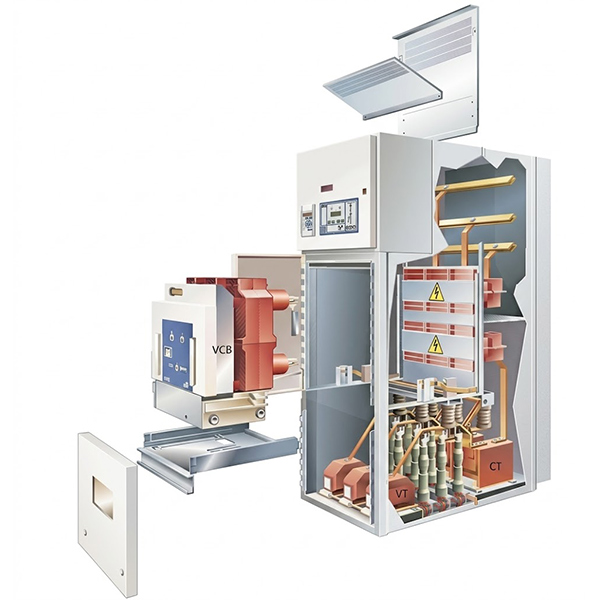
In medium-voltage substations and industrial plant distribution rooms, VCBs are typically integrated into metal-enclosed switchgear (such as the KYN28 series or other withdrawable metal-clad switchgear).
- Advantages: For space-constrained urban substations or industrial equipment rooms, indoor vacuum circuit breakers—especially those with a withdrawable/truck-mounted design—support modular installation. This greatly optimizes the footprint and allows for rapid inspection and maintenance without disrupting system operation.
Outdoor MV/HV Distribution
Outdoor vacuum circuit breakers are required for overhead lines, long-distance transmission nodes, or remote substations.
- Advantages: For outdoor VCBs at 40.5kV and above (such as pole-mounted or porcelain-insulated breakers), the design features enhanced climate resilience against strong UV radiation, extreme temperature fluctuations, and harsh precipitation. They are frequently used as auto circuit reclosers, integrating with distribution automation systems to achieve automatic fault isolation and service restoration, forming the core of MV/HV overhead distribution networks.


Why Choose Vacuum Circuit Breakers?
Vacuum extinguishing technology has achieved a dominant position in applications ranging from 12kV to 40.5kV and even higher. This globally recognized status stems from its multi-dimensional core value in ensuring ultimate grid safety and driving the transition to green power:
- Superior Arc Quenching: High dielectric strength in the vacuum medium and a small contact gap lead to extremely fast and safe arc extinguishing.
- Low Maintenance & Long Life: Contact wear in the vacuum interrupter is negligible, resulting in a mechanical reliability that far exceeds traditional media.
- Environmental & Safety Compliance: Unlike SF6 gas, vacuum solutions pose no risk of greenhouse effect and produce no toxic by-products, fully aligning with global carbon reduction and environmental regulations.
Conclusion
In summary, the applications of vacuum circuit breaker have long transcended the scope of traditional distribution protection to become a vital link connecting global power energy with modern industrial production. Whether in diverse international distribution grids covering 10kV to 24kV, or in demanding industrial conditions at 35kV/40.5kV and above, VCBs safeguard every flow of power—from traditional manufacturing to the AI compute foundations—with irreplaceable stability.
Faced with the dual challenges of global energy transition and increasing power demand density, choosing the right VCB solution is fundamental to ensuring the long-term robustness and sustainability of power infrastructure.
As an experienced vacuum circuit breaker manufacturer, Liyond provides a comprehensive range of VCBs and matching switchgear from 12kV to 40.5kV+. Whether your project involves petrochemicals, metallurgy, or next-generation compute centers, our technical team is ready to provide customized advice meeting international standards. Contact us today to build a safer and greener power future together.
Get A Free Quote


Power your projects with long-lasting switchgear and switchgear components from Liyond.
