

 EN
EN RU
RU


March 11, 2026
In modern power distribution systems, the operational reliability of medium voltage (MV) switchgear directly dictates the continuity of power supply. Among various stressors, temperature is a critical factor influencing the service life of switching equipment. According to relevant standards for metal-enclosed switchgear, the maximum temperature limit for busbar conductors is typically set at 115°C. This threshold is derived from a maximum design ambient temperature of 40°C plus a permissible temperature rise of 75°C. Consequently, the maximum continuous operating temperature for most insulation materials within air-insulated switchgear (AIS) must be strictly maintained below 115°C.
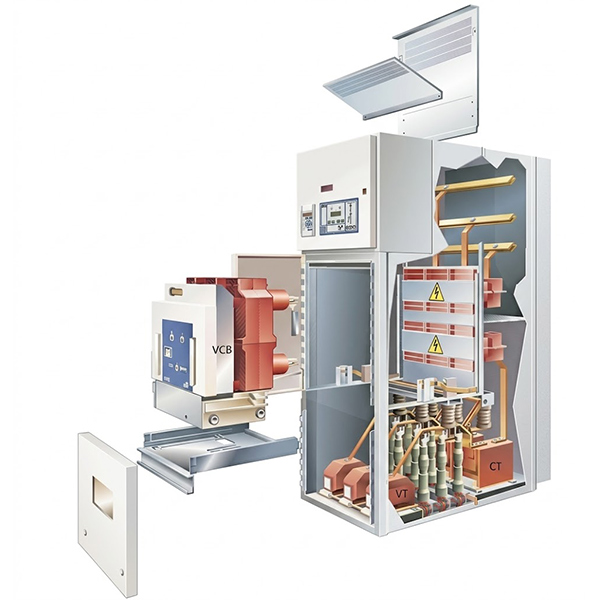
Evidence suggests a strong correlation between internal temperature rise and the degradation of insulation performance. Limiting temperature rise is essential for ensuring the long-term stability of switchgear insulation system; prolonged exposure to overtemperature conditions inevitably triggers thermal aging effects, leading to diminished dielectric strength or total insulation failure.
Thermal Aging Mechanism of Switchgear Insulation Materials
Epoxy resin, a common insulation material in MV switchgear, typically has a Class B thermal endurance rating, meaning its expected life is 20,000 hours at 130°C. The physical correlation between insulation life and temperature follows the Arrhenius equation:
(1)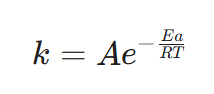
In Equation (1), k represents the chemical reaction rate constant, R is the molar gas constant, T is the thermodynamic temperature, Ea is the apparent activation energy, and A is the pre-exponential factor (frequency factor).
By taking the natural logarithm and rearranging the terms, Equation (1) can be transformed into a generalized linear expression:
(2)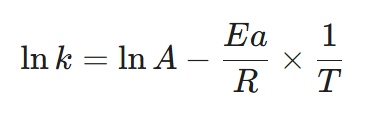
Since A, Ea, and R are constants, this expression yields a straight line in a coordinate system with a slope of (Ea/R) and an independent variable of (1/T).
Empirical Rule for Insulation Life Assessment
The Arrhenius expression is frequently employed to estimate the expected life of electrical insulation (represented by variable k). Although various insulation materials are used in switchgear, a common engineering rule of thumb states that for every 10°C increase in average operating temperature, the electrical insulation life is halved. Since dielectric capability is the core metric for insulation health, the Arrhenius formula is widely used for dielectric life assessment. This also serves as the theoretical foundation for Accelerated Life Testing (ALT), where insulation samples are subjected to controlled high-temperature ovens to compress the time to failure.
Synergistic Effects of Operating Environment and Load Current
The temperature of busbars and their supporting insulators is influenced by both the ambient temperature surrounding the busbars and the load current.
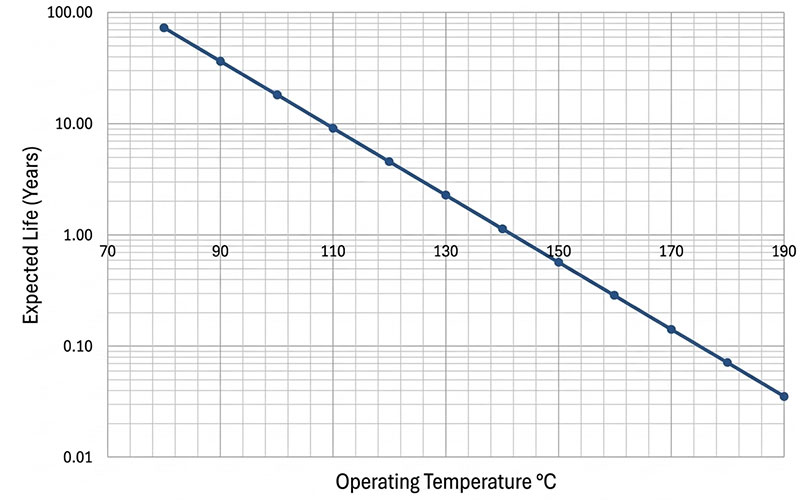
Taking a Class B epoxy resin (20,000-hour rating) as an example, Figure 1 illustrates the expected life of insulators across various operating temperatures. Assuming a busbar temperature of 110°C (with a 5K safety margin) under full-rated load, the expected service life is 9.1 years. However, if the switchgear operates at a lower ambient temperature (e.g., 20°C), reducing the total temperature by 20°C, the expected life can extend beyond 36 years.
Case Study: Impact of Operating Current on MV Switchgear Insulation Life
The heat dissipation of switchgear is closely linked to the operational load. In practice, factors such as standby states and actual operating current (CT current) must be considered.
For a switchgear unit rated at 3150A, if the actual operating current drops to 2800A, the power loss decreases to 2080W. Due to the square relationship between current and heat generation, if 100% load current produces a 70°C rise, an 80% load generates only about a 45°C rise (64% of 70°C). Compared to full-load conditions, the operating temperature is reduced by 25°C, potentially increasing the expected life from 9 years to approximately 50 years.
In real-world applications, results vary depending on the enclosure’s heat dissipation area, IP rating, and ventilation conditions. Based on IEC 60890 calculations, the temperature rise curves for a 3150A switchgear at various currents are shown in Figure 2; at an operating current of 2600A, the rise is 51K. Given an ambient temperature of 40°C, the operating temperature reaches 91°C, resulting in an insulation life of up to 35 years.
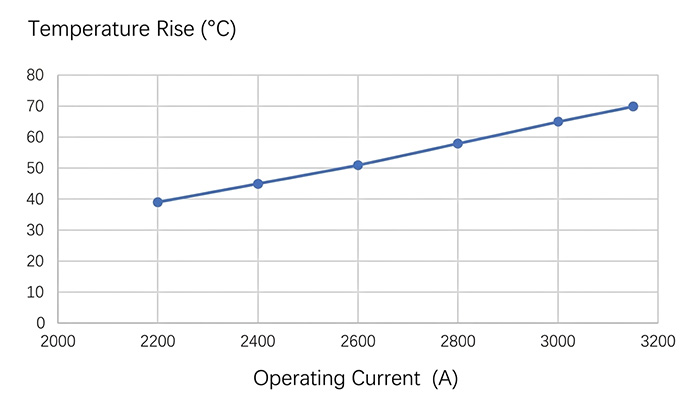
This case study clearly demonstrates the dominant role of temperature in determining insulation life and explains why properly applied electrical equipment can remain in excellent condition after 40 years of service. While ambient temperature is significant, the actual operating current has a more profound impact due to its non-linear square relationship with heat.
Impact of Temperature on Partial Discharge in Insulators
Furthermore, temperature significantly affects the partial discharge (PD) performance of electrical insulators. Partial discharge refers to localized electrical discharges within an insulation system that do not completely bridge the distance between electrodes.
Under an alternating electric field, the distribution of field strength is inversely proportional to the dielectric constant. Consequently, if air bubbles exist within the solid dielectric, the field strength inside the bubbles will be higher than in the surrounding material. Since the breakdown strength of air is much lower than that of solid dielectrics, these bubbles discharge first, resulting in PD. For AIS, temperature and humidity are critical environmental factors that induce PD damage; high temperature and high humidity environments exacerbate the severity of partial discharge.
Micro-mechanisms of Insulation Degradation caused by Partial Discharge
During partial discharge, discharges occurring within internal air gaps (bubbles) generate space charges and lead to charge accumulation. This creates an internal voltage opposite to the applied field, making the bubble discharge an intermittent process characterized by a series of pulses.
Electrons and ions generated by PD are accelerated by the electric field, often attaining energies higher than the chemical bond energies of the polymer insulation. The impact of these charged particles against the cavity walls can break chemical bonds within the insulator. Additionally, localized high temperatures at the discharge site can cause thermal cracking of the insulation material, while chemically active species generated during discharge corrode the material, ultimately leading to the degradation of dielectric properties.
Conclusion
In summary, temperature is not only a key indicator of MV switchgear health but also the primary variable determining the life cycle of the insulation system. Analysis through the Arrhenius law and practical load cases confirms that insulation degradation is a non-linear process driven by temperature.
To ensure long-term grid safety, maintenance strategies should employ online temperature monitoring to capture anomalies at busbars and joints, preventing localized overheating caused by poor contact or overloads. Simultaneously, adequate ventilation in the switchgear room must be maintained to reduce the impact of ambient temperature on total rise, thereby gaining higher insulation life margins. Furthermore, in high-temperature and high-humidity environments, monitoring PD signals is crucial to prevent insulation breakdown caused by the synergistic effects of thermal and electrical aging.
As one of the experienced MV switchgear manufacturers in the power distribution sector, we are committed to providing high-quality MV and HV complete switchgear systems and core components. Our product line includes comprehensive switchgear systems for demanding environments, as well as precision accessories such as high-reliability switchgear heaters and high-performance insulators.
Whether you are building a high-performance distribution network or seeking to replace and upgrade existing equipment, we provide solutions that meet diverse standards and offer exceptional reliability and thermal stability. Please contact our technical experts to discuss how we can support the long-term stable operation of your power distribution systems.
Get A Free Quote


Power your projects with long-lasting switchgear and switchgear components from Liyond.
