

 EN
EN RU
RU

 Home/Blogs/Industry Knowledge/SF6-Free Switchgear Solutions: Green Switchgear Trends & Engineering Challenges
 June 24, 2026
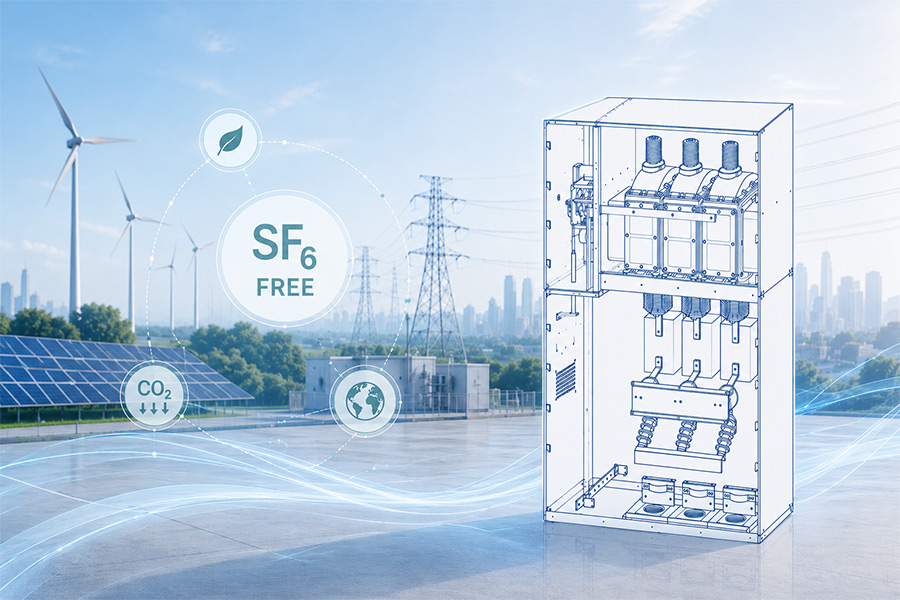
As global power distribution networks transition toward low-carbon and high-reliability operations, the selection of power infrastructure is undergoing significant change. In the context of full lifecycle asset management, balancing operational reliability, environmental sustainability, and maintenance efficiency has become a critical topic for the power engineering sector. While SF6 (Sulfur Hexafluoride) technology has long been a pillar of the industry due to its superior insulation performance, the growing demand for green power has brought SF6-Free switchgear solutions into the spotlight, marking a major direction for industry evolution. An in-depth analysis of the advantages and engineering challenges brought by this technological transformation is essential for grasping the pace of distribution network modernization.
The Shift Toward SF6-Free: What’s Driving the Transition?
The rise of SF6-Free technology is not merely a technical iteration; it is a complex and multi-dimensional evolution driven by the global low-carbon transition, pressure from environmental regulations, and breakthroughs in advanced material science.
First, the global consensus on carbon neutrality goals is reshaping the selection standards for power infrastructure. With environmental performance indicators under the ESG (Environmental, Social, and Governance) framework becoming increasingly stringent, seeking full-lifecycle, low-emission solutions has become a core strategy for enterprises to achieve sustainable operations.
Second, the dynamic evolution of the regulatory environment is a key lever driving industry transformation. International institutions are gradually institutionalizing restrictions on the use and emissions of fluorinated gases (F-gases). Various regions have released clear timelines for technical transitions, forcing the power industry to shift from passive compliance to actively seeking environment-friendly alternatives. For instance, regulations in Europe and other regions have specified phase-out timelines for SF6 in medium-voltage switchgear, guiding the industry to explore and adopt alternative technologies. This has served as a clear policy beacon, accelerating the global transition toward SF6-Free solutions.
Furthermore, the leap in technological maturity provides the fundamental guarantee for this transition. For a long time, the technical bottleneck for SF6-Free solutions was whether they could match traditional technology in reliability and economic efficiency. Today, with the maturity of diverse paths such as vacuum arc extinction combined with solid insulation, and eco-friendly gas insulation, the industry has effectively broken the “SF6 dependency.” Advances in high-performance insulation materials and precision manufacturing processes provide the necessary support for the commercial implementation of these alternatives, ensuring that green power architectures are both reliable and feasible.
SF6-Free Switchgear vs. Traditional SF6-Insulated Switchgear
In current power distribution infrastructure, SF6 gas insulated switchgear and SF6-Free switchgear each possess distinct technical advantages and application boundaries. In engineering selection, these represent differentiated configurations based on specific project requirements, environmental goals, and operational needs, rather than a simple one-for-one substitution.
| Feature Dimension | SF6-Insulated Switchgear (Mature Solution) | SF6-Free Switchgear (Green Forward-looking Solution) |
| Insulating Medium | Sulfur Hexafluoride (SF6) gas | Dry air, Nitrogen, eco-friendly gas mixtures, or solid insulation |
| Technical Validation | Highly standardized, long-term market validation | Industry front-line innovation, rapidly adapting to emerging needs |
| Application Scenarios | Complex, high-load, and general distribution environments | Priority on environmental protection, new green stations, harsh environments |
| Maintenance Focus | Requires routine gas density monitoring and end-of-life recovery (SF6 gas density monitor) | Simplified maintenance, reduced compliance management costs |
| Environmental Property | Requires controlled management of SF6 gas | No F-gas emissions, compliant with environmental trends |
| Compactness | High insulation strength, easy to achieve extreme compactness | Electrical clearances must be considered, usually larger volume |
| Environmental Tolerance | Strong resistance, suitable for various harsh conditions | More sensitive to humidity, condensation, and other factors |
| Digital & Interconnectivity | Requires external expansion for grid automation; high cabinet commonality | Native digital interfaces; modular design, focused on system scalability |
Traditional SF6 switchgear, relying on its excellent insulation stability and high technical maturity, remains the backbone for ensuring high reliability in long-cycle, high-load, and complex operating environments. Meanwhile, SF6-Free switchgear solutions, leveraging cutting-edge eco-friendly materials and integrated design, offer power companies critical asset options for reducing compliance risks, simplifying maintenance workflows, and responding to ESG strategic guidance. Together, they form a complementary architecture for the next generation of green power assets.
Application Scenarios: Where SF6-Free Solutions Excel
SF6-Free technology exhibits significant selection advantages in the following typical scenarios, covering everything from new projects to existing grid switchgear retrofit:
- Greenfield Power Infrastructure: For projects seeking top-tier green building standards, such as data centers, urban core districts, and high-end commercial buildings, SF6-Free solutions are the preferred choice for infrastructure decarbonization. The absence of F-gas emissions directly improves the project’s ESG score and eliminates potential SF6 leakage safety hazards in indoor environments.
- Retrofit & Replacement of Existing Grids: For SF6 switchgear at the end of its lifecycle, SF6-Free technology provides a “seamless migration” path. During overhauls or upgrades, replacing equipment with SF6-Free units not only facilitates digital transformation but also eliminates expensive SF6 gas recovery and disposal costs at the end of the asset’s life. The key to such projects lies in assessing interface compatibility and physical installation dimensions, making modular switchgear products the priority.
- Environmentally Sensitive & Confined Spaces: In compact underground substations with high air quality requirements or lack of forced ventilation, SF6-Free equipment removes the need for gas monitoring and complex anti-leakage ventilation systems, reducing the complexity of civil engineering and maintenance.
Engineering Challenges in SF6-Free Switchgear Development
In the transition from traditional to SF6-Free solutions, engineering teams must overcome multiple physical and mechanical challenges of MV switchgear design to ensure performance is not compromised.
Achieving Compact Design Without SF6
In an SF6 environment, high insulation strength allows for miniaturized design. Removing SF6 presents engineers with the challenge of maintaining voltage withstand levels without increasing cabinet dimensions. Current engineering strategies combine electric field control with material optimization: high-precision electric field simulation is used to optimize the geometry of contacts and conductive parts, effectively suppressing local field distortion, while high-performance solid insulation materials ensure reliable electrical clearances within a compact cabinet.
Reliability and Mechanical Endurance in Integrated Designs
Eco-friendly switchgear often adopts three-position or highly integrated designs. In the absence of SF6 as an arc-extinguishing medium, designers must prioritize enhancing the mechanical stiffness of the core mechanism and the durability of interlock systems to prevent wear or logic failures during frequent long-term operation.
Intelligent Interfacing for Feeder Automation
Green switchgear serves as a critical node in modern distribution automation. During the design phase, it is essential to standardize the integration of secondary circuits. Enabling “plug-and-play” connections between sensors, controllers, and Feeder Terminal Units (FTUs) or Distribution Terminal Units (DTUs) to minimize field wiring work is a primary focus of current R&D.
Choosing the Right SF6-Free Solutions: Key Engineering Considerations
When selecting equipment for specific projects, engineers should evaluate the following four technical dimensions to ensure long-term robust operation:
- Environmental Tolerance: Evaluate the insulation structure’s performance under harsh temperature and humidity conditions. Since SF6-Free equipment (such as air-insulated units) is sensitive to condensation, the creepage distance design and moisture-proofing of insulation components must be prioritized.
- Mechanical Reliability: The operating mechanism is the core component. Priority should be given to mechanical life test reports to ensure that the linkage mechanism maintains precise interlocking during frequent operations, meeting modern grid requirements for high-frequency switching.
- Retrofit Compatibility: For existing grid upgrades, evaluate the physical dimensions and installation interface compatibility. Superior solutions should feature flexible structural designs that match existing frames, avoiding unnecessary civil engineering costs.
- Lifecycle Maintenance: Evaluate the maintenance requirements from installation to decommissioning. Focus on the availability of modular components, standardized secondary interfaces, and visual status indication to reduce the difficulty of future automation upgrades and daily inspections.
Liyond Engineering Example: High-Performance Eco-Friendly Solutions
To address these industry challenges, we have developed a series of eco-friendly vacuum load break switch designed to provide efficient retrofit solutions for power grids. The XGN-24/630-20 eco-friendly load break switch features:
- Flexible Structural Compatibility: Designed for varying cabinet space requirements, the product supports phase spacing configurations of 210mm and 230mm, ensuring efficient replacement without complex civil or cabinet structural adjustments during legacy equipment upgrades, effectively reducing overall project costs.
- High-Integration Functional Design: The vacuum arc extinction unit is integrated with a three-position disconnector (featuring isolation and grounding functions) into a single physical unit. This design significantly simplifies equipment complexity, with core component commonality exceeding 90%. It features standardized secondary terminal interfaces that support seamless connection to Feeder/Distribution Terminal Units (FTU/DTU), drastically enhancing field maintenance efficiency and intelligent management capabilities.
- Reliable Eco-Friendly Insulation Architecture: By eliminating SF6 gas, we utilize a “Vacuum arc extinction + Clean dry air” combination to achieve zero greenhouse gas emissions at the source. Simultaneously, through optimized insulation configuration and precise electric field control, this LBS maintains long-term structural stability and operational logic precision even in harsh electrical and mechanical environments, meeting the high-frequency switching requirements of modern power grids.
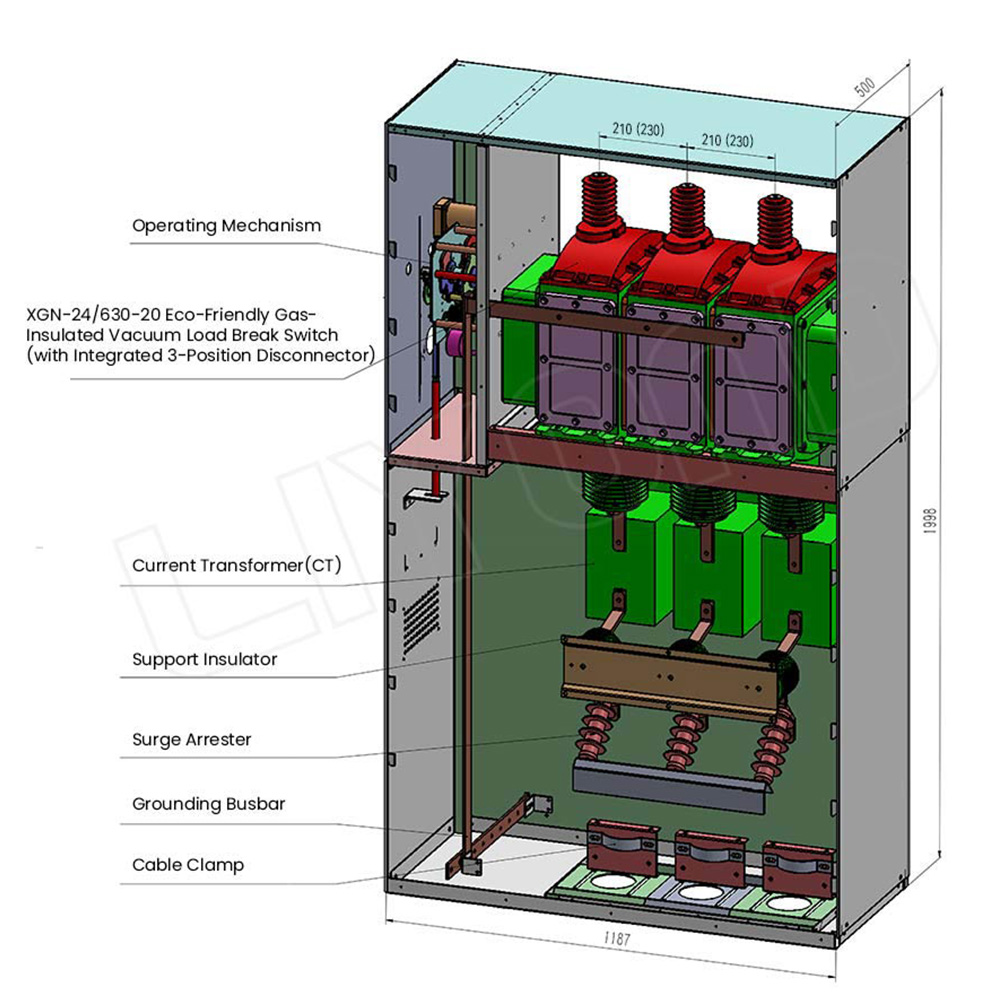
Additionally, for new distribution projects or full-scale replacement needs, we offer 24kV SF6-Free eco-friendly RMU switchgear that incorporates the LBS components mentioned above. This system utilizes a sealed stainless-steel gas tank structure combined with clean dry air insulation, providing users with a high-performance, full-lifecycle zero-emission cabinet architecture that meets complex environmental and automation requirements.
Embracing the Future: Accelerating the Transition to SF6-Free Power Infrastructure
The evolution of SF6-Free technology is more than just a response to regulatory compliance; it is a critical turning point in the transformation of power infrastructure toward a sustainable operational paradigm. While pursuing environmental friendliness and zero emissions, solving the challenges of reliability and compactness through engineering is a mission shared by every power industry professional.
From core components to full cabinet systems, selection and application should always return to a deep adaptation to specific operating environments, maintenance cycles, and automation requirements. As the green transition of power distribution networks deepens, choosing partners with profound technical expertise and on-site implementation capabilities will be key to ensuring the long-term stable operation of power systems.
Among MV switchgear manufacturers, Liyond is committed to providing global power users with high-quality switchgear components and integrated cabinet solutions. We stay at the forefront of the industry’s green transition, continuously driving technological innovation to provide you with high-performance, eco-friendly switchgear. If you have specific product requirements or would like to learn more about our eco-friendly solutions, please feel free to review our product catalog or contact our professional team directly.
Get A Free Quote


Power your projects with long-lasting switchgear and switchgear components from Liyond.
