

 EN
EN RU
RU


June 15, 2026
In the operation and maintenance of medium-voltage (MV) power distribution systems, switchgear serves as a critical asset. Its operational status directly impacts the stability of power supply for industrial facilities and public utilities. As equipment ages, the degradation of core components and the obsolescence of spare parts lead to increasing maintenance challenges. Simultaneously, increasingly stringent safety regulations and the demand for digital transformation have set new standards for the response speed and monitoring capabilities of power distribution networks. When faced with the performance bottlenecks of aging equipment, a complete system replacement often entails high capital expenditure and extended downtime. Modernization and retrofitting offer a pragmatic alternative. This approach not only addresses current failures and aging risks but also elevates the safety, reliability, and operational efficiency of power infrastructure while optimizing costs.
What Is MV Switchgear Modernization and Retrofitting?
The modernization and retrofitting of MV switchgear is an integrated asset-upgrading strategy designed to bridge the gap between legacy equipment and modern operational standards.
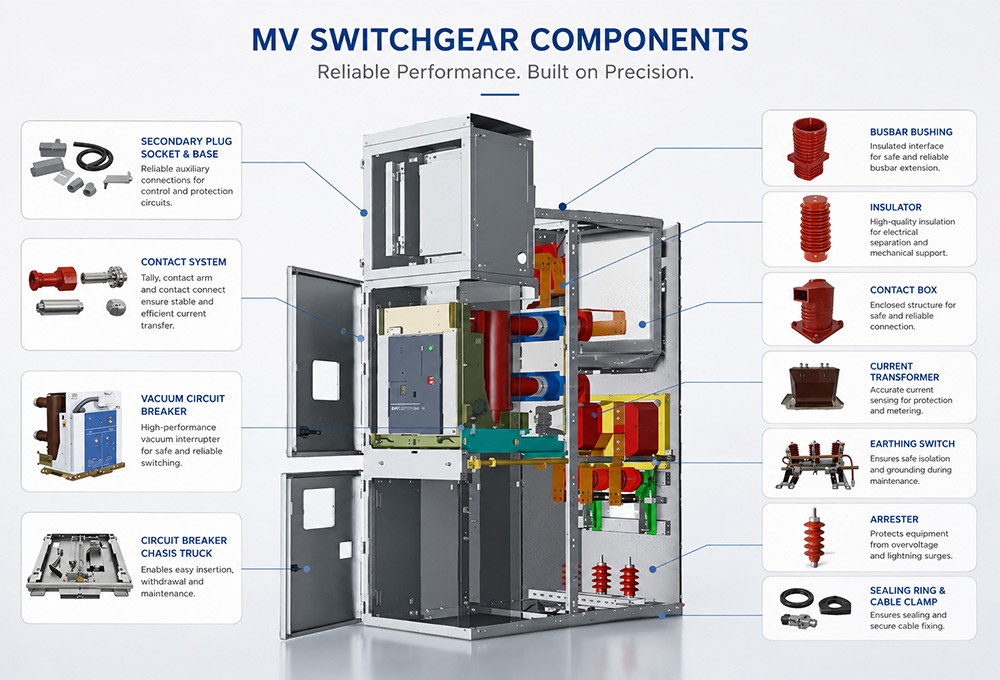
We view “Retrofitting” as the foundation for restoring physical performance: by replacing obsolete or discontinued core switchgear components—such as vacuum circuit breakers, interlocking devices, and epoxy resin insulators—we eliminate hazards caused by wear and restore the basic physical reliability of the equipment.
“Modernization” is the extension of performance elevation: it involves applying next-generation hardware with faster breaking times and enhanced protective capabilities, alongside the integration of digital communication interfaces, to fundamentally improve system safety boundaries and operational effectiveness.
In practical application, the two are highly complementary and together form a complete asset management solution: retrofitting guarantees the continuous operation of the equipment, while modernization provides the asset with higher reliability and performance ceilings. Users can achieve the transition from “functional” to “efficient, intelligent, and compliant” without the need to dismantle the existing enclosure structure.
When to Consider Modernizing or Retrofitting Your MV Switchgear?
Developing a upgrade plan should be based on an assessment of the equipment’s technical condition and maintenance costs. It is advisable to initiate an upgrade process when the following conditions occur:
- Equipment Approaching End-of-Life: The original equipment manufacturer no longer provides support for core spare parts, leading to significant maintenance difficulties, where the absence of critical components increases the risk of system shutdown.
- Rising Failure Rates and Maintenance Costs: The frequency of equipment failure increases significantly, and the long-term human and material costs of repairs exceed the economic investment required for an upgrade via new components.
- Technical Standards and Safety Compliance: Existing control logic, mechanical interlocking systems, or protection functions fail to meet current safety regulations or industrial operational efficiency indicators, such as a lack of arc fault protection capability.
- Increasing System Load and Capacity Demands: With the expansion of production scale, original electrical specifications or protection coordination logic can no longer support current load requirements, necessitating an upgrade of components to improve system capacity and tripping precision.
- Digital Transformation and Intelligent Maintenance Needs: The power distribution system lacks necessary communication interfaces or data acquisition capabilities, preventing integration with modern remote monitoring systems and limiting the visualization and fine-grained management of the power grid.
Major Steps for MV Switchgear Upgrades
- Step 1: Pre-project Assessment and Site Survey: Conduct a comprehensive health check and baseline assessment of the existing switchgear to define project boundaries and identify potential installation risks.
- Step 2: Structural Compatibility and Interface Mapping: Before component selection, precise measurements of the internal switchgear space, installation rail dimensions, mechanical interface positions, and busbar layout are required to ensure that new components can be installed without major structural modifications.
- Step 3: Component Selection for Electrical and Mechanical Optimization: Selection must be based on system-level electrical capacity and mechanical precision requirements. By choosing high-reliability circuit breakers and precision control components, system response speed and mechanical service life are enhanced.
- Step 4: Validation of Interlocking and Control Logic: Verify the compatibility of new components with the original interlocking logic, ensuring that locking functions remain fully effective post-retrofit, and conduct comprehensive simulation tests of the control logic.
- Step 5: Commissioning and Final Handover: Perform joint commissioning of the system after installation to confirm that electrical parameters and protection logic meet requirements, and archive project documentation to ensure the delivered system complies with safety standards.
Overcoming Technical Challenges in MV Switchgear Upgrade Projects
The core challenge in MV switchgear upgrade projects lies in integrating modern components into legacy power distribution systems. This process requires overcoming technical barriers such as physical size mismatches, discrepancies in electrical parameters, and control logic compatibility issues.
First, precise adaptation of physical interfaces is the foundation of project success. The internal design of legacy switchgear often varies, making it difficult for general-purpose components to be installed directly. Therefore, precise measurements of installation space, rail positions, busbar interfaces, and circuit breaker operating mechanisms are required before the project begins. Customized interface designs eliminate mechanical stress, ensuring smooth alignment between new and old components and preventing operating mechanism failures or poor contact caused by accumulated stress.
Second, the compatibility of control logic and safety interlocking systems is the focus of technical integration. There are significant differences in control philosophy between equipment of different eras. When integrating new components, it is essential to ensure that their control circuits are perfectly matched with original interlocking devices; any minor logic deviation could lead to locking failure or tripping faults. Analyzing the existing mechanical interlocking logic in depth to ensure that the contact feedback signals of the new equipment can accurately respond to and drive the original safety interlocking system is at the core of the design solution.
Finally, functional verification and system testing post-installation are key to ensuring safe operation. The core of an upgrade is not merely replacing parts but re-engineering the system’s functionality. During the installation phase, multi-dimensional compatibility simulations and electrical functional debugging must be conducted, especially re-testing interlocking logic under high-voltage conditions. By utilizing rigorously verified components, risks during design and installation can be minimized, ensuring that the retrofitted power distribution system meets current reliability and safety requirements.
Benefits of MV switchgear modernization
Upgrading Switchgear Components for Cost Optimization
Compared to dismantling the entire switchgear and installing new equipment, replacing key wear-prone components is a solution that significantly reduces capital expenditure. This method extends the total lifecycle of the asset while keeping the budget under control.
Extending Switchgear Service Life
After decades of operation, the enclosure structure of many legacy switchgears remains in good condition, while internal components are often the performance bottleneck. By replacing these core parts, the technical life of the equipment can be effectively reset, allowing infrastructure to continue running safely and reliably.
Enhancing Switchgear Performance, Reliability and Safety
Employing modern components with shorter opening times and higher mechanical strength, combined with digital monitoring means, can reduce arc fault risks, minimize unexpected downtime, and meet the high-standard reliability requirements of modern industry for power distribution systems.
Supporting Sustainability and Operational Efficiency
- Environmental Sustainability and ESG Contribution: Compared to dismantling old cabinets for scrap and manufacturing new switchgear, modernization significantly reduces metal resource consumption and carbon emissions, helping companies fulfill their Environmental, Social, and Governance (ESG) responsibilities.
- Shortening Downtime: Modernization solutions typically do not require the removal of original enclosure structures, greatly shortening the project implementation cycle, thereby minimizing production line downtime and ensuring operational continuity.
Why choose Liyond switchgear components for your switchgear retrofit?
- Comprehensive Portfolio of MV Switchgear Components: We provide a series of high-performance MV switchgear components, including vacuum circuit breakers, load break switches, earthing switches and instrument transformer products, and offer customized services to ensure they can be seamlessly integrated into various MV switchgear systems.
- Proven Expertise in Technical Compatibility and Retrofitting: We provide not only high-quality components but also professional selection guidance and compatibility assessments, assisting users in anticipating and mitigating design risks at the project’s inception to ensure the efficient execution of the retrofit solution.
- Commitment to Long-term Reliability: We are dedicated to providing high-performance, long-life components, ensuring that the retrofitted switchgear system can operate stably for the long term, providing sustained reliability and safety for your power assets.
Conclusion
The modernization of MV switchgear is a strategic investment aimed at enhancing the long-term value, safety, and operational reliability of infrastructure. By using high-quality components for precise retrofitting and upgrading, users can break through the performance limitations of legacy equipment and achieve highly efficient upgrades of their power distribution systems while strictly controlling budgets. Choosing high-performance hardware support is the solid first step toward building a modern, sustainable, and future-ready power environment.
Get A Free Quote


Power your projects with long-lasting switchgear and switchgear components from Liyond.
