

 EN
EN RU
RU


August 07, 2025
In modern power systems, the stability and safety of power transmission and distribution are paramount. This relies on the synergistic operation of various critical components, among which electrical insulators play an indispensable role. The fundamental function of an electrical insulator is to isolate live conductors from the ground or from conductors at different potentials, preventing current leakage and ensuring the safe operation of electrical equipment. Given their central position in guaranteeing the reliable operation of power infrastructure, a comprehensive understanding of electrical insulators’ diverse characteristics and crucial functions is essential.
What is an Electrical Insulator?
An electrical insulator, as the name suggests, is a material or device that does not conduct electricity, or conducts it very poorly. In electrical engineering, insulators are primarily used to isolate live conductors from supporting structures (such as poles, towers, switchgear enclosures, etc.), preventing current from flowing through unintended paths. This ensures both the efficiency of power transmission and the safety of personnel and equipment. Electrical insulators must possess high dielectric strength, excellent weather resistance, and sufficient mechanical strength to withstand various electrical, mechanical, and environmental stresses.
Types of Electrical Insulators
Electrical insulators are diverse, varying in function, structure, application environment, and materials used. They can therefore be precisely classified according to different dimensions. This multi-dimensional classification helps us to more comprehensively understand the variety of insulators and their specific roles within power systems.
Classification by Material
The material of an insulator is a critical factor determining its electrical, mechanical, and thermal properties, as well as its scope of application and cost-effectiveness. Different materials provide insulators with unique advantages and limitations.
1. Epoxy Resin Insulators
Epoxy resin insulators are a type of composite insulator, manufactured with epoxy resin as the base material. Liyond is an experienced epoxy insulators manufacturer that specializes in these products. Epoxy resin boasts excellent electrical insulation properties, high strength, superior corrosion resistance, good dimensional stability, and excellent plasticity. By incorporating various fillers (such as quartz powder, alumina powder) and curing agents, its dielectric constant, thermal expansion coefficient, and mechanical strength can be precisely adjusted to meet diverse application requirements. Due to their outstanding comprehensive performance and adaptability, epoxy resin insulators are widely used within medium and high voltage switchgear, GIS gas insulated switchgear (GIS bushing), transformers, and instrument transformers to support and isolate busbars and other live components. They are particularly favored in compact, maintenance-free electrical equipment with stringent partial discharge requirements, serving as critical internal insulation components in modern power apparatus. Their oil-free and miniaturized characteristics also align with the development trends in power equipment.

2. Porcelain Insulators
Porcelain insulators are among the earliest and most widely used types of insulators. Their main body is made from electrical ceramic materials (such as kaolin, quartz, and feldspar) fired at high temperatures. They exhibit excellent electrical insulation properties, high temperature resistance, corrosion resistance, and high mechanical strength. Porcelain insulators are typically brown or gray with a smooth surface to prevent contamination and flashover. Their manufacturing process is mature, and their cost is relatively low, though they are heavy and have relatively weaker impact resistance. Due to their durability, cost-effectiveness, and strong weather resistance, porcelain insulators are primarily used in overhead transmission lines as suspension or post insulators to support and isolate conductors, ensuring safe power transmission over long distances. They are also widely applied in outdoor substations, distribution devices, and railway electrification systems, withstanding various environmental challenges. Despite competition from composite insulators, porcelain insulators maintain an important position due to their long-term operational reliability and economic advantages.
3. Glass Insulators
Glass insulators are made from special toughened glass. Compared to porcelain insulators, their main advantages include higher mechanical strength and smaller size and weight. Their transparent nature allows for easy visual inspection of internal defects (such as cracks or bubbles), simplifying maintenance. Furthermore, glass insulators typically self-shatter upon severe failure, creating a clear break that aids in quickly locating fault points and reducing maintenance difficulty, though the resulting fragments can pose a safety hazard. Due to their unique self-shattering characteristic and ease of fault detection, glass insulators are widely used in medium and low voltage overhead transmission and distribution lines, including industrial and domestic circuits. They are also employed in some medium and high voltage transmission lines, especially in scenarios requiring rapid identification and replacement of faulty insulators to enhance line operational reliability. With technological advancements, surface treatment techniques for glass insulators are continuously improving to enhance their anti-pollution flashover performance.
Classification by Structure or Application Type
Insulators are categorized into various structural or application types based on their specific installation form and primary function within power systems. The design of these types aims to meet particular mechanical support, electrical isolation, or penetration insulation requirements.
1. Suspension Insulators
Suspension insulators are primarily used in overhead transmission lines. Their core function is to suspend conductors from towers and withstand both the vertical gravitational force and horizontal tension from the conductors. They typically consist of multiple insulator units (such as disc or cap-and-pin types) connected in series. By adjusting the number of units in the string, they can accommodate different voltage levels, providing sufficient insulation distance and mechanical strength. This flexible structure makes them the most widely used type in transmission lines, particularly for high and extra-high voltage long-distance transmission, ensuring power transmission stability and safety. Their ease of replacing individual damaged units also helps reduce maintenance costs.
2. Pin Insulators
Pin insulators are an early type of insulator commonly used in overhead lines, named for their installation method where they are fixed to a cross-arm via a pin. They are typically made of porcelain or glass, with a groove at the top for tying the conductor. Their structure is relatively simple and compact, and they are easy to install. Primarily used in low and medium voltage distribution lines, such as urban and rural power grids, they provide basic insulation and support. Their limitation lies in relatively lower mechanical strength and difficulty in providing sufficient creepage distance at higher voltage levels, which is why they have gradually been replaced by suspension insulators in high voltage lines.
3. Post/Support Insulators
Post/support insulators represent an important branch within the insulator family. Their key characteristic is that they not only provide electrical insulation but must also withstand mechanical stresses from conductors, busbars, or other live components. They typically have a columnar or cylindrical structure with high bending, compression, and torsional strength, enabling them to stably support live components and ensure their fixed position and electrical isolation under various operating conditions. These insulators are widely used in substations, switchgear, distribution apparatus, and busbar structures as critical elements for fixing and supporting live components, ensuring internal electrical clearances and structural stability of the equipment. Their design often considers installation methods (e.g., vertical or horizontal mounting) and required mechanical load ratings.
4. Bushings
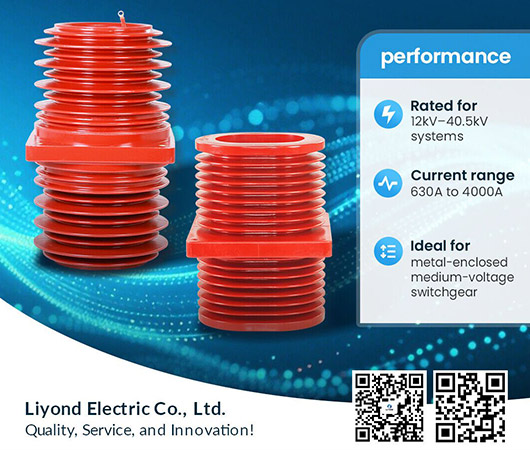
A bushing is a specialized insulator whose primary function is to allow a live conductor to safely pass through an earthed enclosure (such as a transformer tank wall, switchgear panel, or wall penetration), while providing reliable electrical insulation and sealing. Bushings have a conductor passing through their interior, and their exterior typically features insulating sheds or skirts to increase creepage distance and anti-pollution flashover capability, adapting to outdoor environments; indoor bushings, conversely, prioritize compactness and partial discharge performance. They not only provide insulation but also act as a seal, preventing leakage of internal insulating media (such as transformer oil) or ingress of external moisture. Liyond is also a professional epoxy bushing manufacturer and our bushings are indispensable components in medium and high voltage equipment like transformers, circuit breakers, and switchgear, with their design complexity significantly increasing with higher voltage levels.
5. Strain Insulators
Strain insulators are primarily used to withstand the immense tension from conductors at corners, terminals, or over long spans (such as rivers or valleys), while simultaneously providing reliable electrical insulation. Their design emphasizes extremely high mechanical strength and tensile capability, often consisting of multiple suspension insulator units connected in series, or utilizing special high-strength insulating materials and structures, such as composite long-rod insulators. Their role is to ensure that the line maintains its electrical isolation integrity even under extreme mechanical stress, playing a crucial role particularly at angle towers and dead-end towers in transmission lines to guarantee stable line operation. Their failure typically manifests as mechanical breakage rather than electrical flashover.
Classification by Voltage Level
The design and performance of insulators are closely related to the voltage level they are subjected to, making this the most fundamental and crucial classification standard in power systems. Insulators for different voltage levels vary significantly in size, choice of insulating materials, creepage distance, and withstand voltage test requirements, all to ensure safe and reliable operation at specific rated voltages. International voltage level classifications are generally based on the equipment’s rated voltage or the system’s maximum operating voltage.
1. Low Voltage Insulators
Low voltage insulators are typically used in distribution systems with rated voltages below 1 kV, as well as in domestic electrical appliances and industrial control circuits. These insulators primarily meet basic electrical isolation and mechanical support needs, featuring relatively simple designs focused on cost-effectiveness and ease of installation. They are widely applied in household and commercial building distribution boxes, lighting circuits, and electrical connection points in small industrial facilities, ensuring daily electrical safety.
2. Medium Voltage Insulators
Medium voltage insulators are suitable for power systems with rated voltages between 1 kV and 72.5 kV, and are widely used in urban and rural distribution networks, industrial power supply, and medium-sized substations. The design of these insulators requires a balance between insulation performance, mechanical strength, and economic viability to meet the growing demands of urbanization and industrialization. They serve as critical links connecting high voltage transmission with low voltage consumers, ensuring stable regional power supply.
3. High Voltage Insulators
High voltage insulators are applied in transmission systems and large substations with rated voltages between 72.5 kV and 245 kV. This voltage level constitutes a vital part of the power transmission backbone network. The requirements for high voltage insulators are more stringent; they must possess higher dielectric strength, superior anti-pollution flashover performance, and greater mechanical load capacity to ensure the reliability of long-distance, high-capacity power transmission, serving as a cornerstone for stable grid operation.
4. Extra High Voltage Insulators
Extra high voltage insulators serve transmission systems with rated voltages between 245 kV and 800 kV. Such systems are typically used for cross-regional, long-distance, high-capacity power transmission and are crucial components of national power grids. The design and manufacturing of extra high voltage insulators are extremely complex, requiring consideration of very large electrical clearances, ultra-long creepage distances, excellent anti-pollution flashover performance, and stable operation capability under extreme weather conditions, representing advanced grid technology.
5. Ultra High Voltage Insulators
Ultra high voltage insulators represent the pinnacle of insulator technology, applied in transmission systems with rated voltages of 800 kV and above (e.g., 1000 kV AC and ±800 kV DC). These systems are primarily used for ultra-long distance, ultra-high capacity power delivery, and are key to building national and even intercontinental power grids. Ultra high voltage insulators face extreme challenges in material performance, structural design, manufacturing processes, and environmental adaptability to cope with extremely high voltages, complex electromagnetic environments, and severe mechanical stresses, ensuring unprecedented levels of power transmission efficiency and reliability.
Classification by Usage Environment
The installation environment of an insulator imposes different requirements on its performance and design, broadly categorized into outdoor and indoor types. This classification considers the insulator’s adaptability to various climatic conditions and pollution environments, ensuring its long-term operational reliability.
1. Outdoor Insulators
Outdoor insulators are exposed to natural elements and must possess excellent weather resistance and anti-pollution flashover performance. They need to withstand erosion from rain, snow, ice, ultraviolet radiation, temperature and humidity fluctuations, and environmental pollutants (such as salt fog, industrial dust). They are typically designed with longer creepage distances and multiple sheds to effectively prevent surface flashover, ensuring insulation reliability under harsh external conditions. Their surface materials often feature hydrophobicity to reduce the formation of water films.
2. Indoor Insulators
Indoor insulators are installed in relatively controlled indoor environments, primarily focusing on dust prevention, moisture resistance, and condensation prevention, with lower requirements for weather resistance. However, due to space constraints and the demand for compact equipment, indoor insulators have very high requirements for partial discharge performance and dielectric strength. This ensures compact insulation within equipment and prevents equipment damage caused by internal discharges. They are typically used in switchgear, transformers, and GIS where internal space is limited.
Typical Insulator Manufacturing Technologies and Processes
Different insulator materials have distinct manufacturing processes. These complex process flows and strict quality controls are crucial for ensuring the performance and reliability of the final product.
1. Epoxy Resin Insulator Manufacturing Process
Epoxy resin insulators are primarily manufactured using casting or molding processes, characterized by their high plasticity, enabling complex shapes and high precision:
- Raw Material Mixing: Liquid epoxy resin, curing agents, fillers (such as quartz powder, alumina powder, used to enhance mechanical strength, thermal conductivity, and reduce shrinkage), and other additives (such as colorants, flame retardants, toughening agents) are mixed uniformly in precise proportions. The mixing process must avoid introducing air bubbles.
- Vacuum Degassing: The mixed resin undergoes degassing under vacuum conditions to thoroughly remove any trapped air bubbles. Air bubbles can severely impair the insulator’s electrical performance (e.g., partial discharge) and mechanical strength.
- Casting/Molding: The degassed resin mixture is poured into preheated molds. Casting is suitable for complex shapes and large insulators; molding is used for mass production and products requiring high dimensional accuracy.
- Curing: Curing takes place under specified temperature and time conditions. The epoxy resin reacts chemically with the curing agent, gradually hardening to form a rigid insulating body. The curing process typically involves initial curing and post-curing (or secondary curing) to ensure complete cross-linking of the resin, optimizing material performance.
- Demolding and Post-Processing: After curing, the insulator is removed from the mold, and necessary trimming, polishing, cleaning, and surface treatments (such as applying hydrophobic coatings) are performed.
- Testing: The finished products undergo comprehensive electrical performance tests (e.g., withstand voltage, partial discharge, dielectric loss), mechanical performance tests (e.g., bending, compression, tensile strength), and dimensional accuracy checks to ensure product quality.


2. Porcelain Insulator Manufacturing Process
The manufacturing of porcelain insulators is a complex and precise ceramic processing procedure:
- Raw Material Preparation: The main raw materials include natural minerals such as quartz, feldspar, and kaolin. These materials are rigorously selected, crushed, and ground into extremely fine powders, then mixed in precise proportions with an appropriate amount of water to form a uniform slurry.
- Forming: The slurry is shaped into the preliminary form of the insulator through methods like extrusion (for columnar parts), slip casting (for complex hollow parts), or pressing (for disc-shaped parts). This step requires precise control over dimensions and density.
- Drying: The formed insulators undergo slow drying in a controlled temperature and humidity environment to gradually remove moisture, preventing cracking or deformation caused by rapid water evaporation during subsequent firing.
- Firing: The dried insulators are fired in a high-temperature kiln (typically above 1200°C). This critical process induces complex physical and chemical changes in the material (such as mullitization), forming a dense porcelain body that imparts high strength, hardness, and excellent electrical insulation properties.
- Glazing: Before or after firing, the insulator’s surface is uniformly coated with a special glaze and then re-fired at high temperatures. Glazing enhances the insulator’s surface smoothness, improving its resistance to contamination, flashover performance, and aesthetic appeal.
- Assembly and Testing: Finally, metal fittings (such as caps and pins) are assembled onto the insulators, followed by rigorous electrical performance tests (e.g., withstand voltage tests, partial discharge tests) and mechanical performance tests (e.g., tensile, bending tests) to ensure the product meets standards.
3. Glass Insulator Manufacturing Process
The manufacturing process for glass insulators combines glass forming with special tempering techniques:
- Raw Material Melting: Primary raw materials such as silica sand, limestone, and soda ash are melted into liquid glass in a high-temperature furnace. The melting process requires strict control over temperature and composition to ensure the purity and homogeneity of the molten glass.
- Forming: The molten glass is rapidly shaped into the precise form of the insulator using methods like pressing or blowing in a mold. This step demands high mold precision to ensure product dimensions and surface quality.
- Tempering Treatment: This is a crucial step in glass insulator manufacturing, imparting superior mechanical strength. The formed glass insulator is rapidly cooled (typically by air quenching), creating a compressive stress layer on its surface and a tensile stress layer internally. This internal and external stress distribution gives the glass insulator higher mechanical strength and impact resistance. When damaged, tempered glass shatters into small, blunt pieces rather than sharp fragments, enhancing safety.
- Testing: The finished products undergo rigorous electrical performance tests (e.g., withstand voltage, flashover tests), mechanical performance tests (e.g., impact strength), and thermal shock tests to ensure their reliability under various operating conditions.
Key Technical Indicators of Electrical Insulators
The quality of an insulator’s performance directly impacts the safety and stable operation of power systems. To quantify and evaluate insulator performance, a series of key technical indicators are widely used. These indicators cover various aspects including electrical, mechanical, and environmental factors, forming the basis for insulator design, manufacturing, and selection.
1. Dielectric Strength
Dielectric strength refers to the maximum electric field strength that an insulating material can withstand without undergoing breakdown. It is a core indicator of an insulator’s resistance to electrical breakdown. Typically expressed in kV/mm or V/mil, a higher dielectric strength indicates a lower risk of breakdown when the insulator is subjected to high voltages, thereby ensuring the reliable operation of electrical equipment.
2. Flashover Voltage and Creepage Distance
Flashover voltage is the voltage value at which surface discharge (flashover) occurs along the surface of an insulator under specific conditions. Flashover typically does not cause permanent damage to the insulator but can lead to momentary system faults. Creepage distance is the shortest distance along the surface of an insulator, following the interface between the insulating body and air. It is a critical design parameter for preventing surface flashover. In humid or polluted environments, a conductive film can easily form on the insulator’s surface, shortening the effective creepage distance and thus reducing the flashover voltage. Therefore, the design of insulator sheds and surface hydrophobicity are crucial for increasing creepage distance and improving anti-pollution flashover performance.
3. Mechanical Strength
Insulators in power systems must withstand not only voltage but also various mechanical loads. Mechanical strength is a crucial indicator of an insulator’s ability to resist mechanical stress and damage, typically including:
- Tensile Strength: The ability to resist pulling forces, particularly important for suspension insulators.
- Compressive Strength: The ability to resist crushing forces, vital for post insulators and bushings.
- Bending Strength: The ability to resist deformation and damage from bending forces, significantly impacting post insulators.
- Torsional Strength: The ability to resist twisting forces, considered in certain specific applications. These indicators ensure that insulators do not suffer structural damage under external loads such as wind, ice, earthquakes, and short-circuit electromagnetic forces.
4. Partial Discharge (PD)
Partial discharge refers to localized electrical discharges that occur within or on the surface of an insulator under strong electric fields, without completely bridging the insulation. While partial discharge itself may not immediately lead to insulation breakdown, its long-term effects can gradually degrade the insulating material, eventually causing insulation failure. Therefore, the level of partial discharge is an important indicator for evaluating the internal insulation quality and lifespan of medium and high voltage insulators, especially in solid insulating materials like epoxy resin, where it is strictly controlled.
5. Thermal Performance
Insulators are affected by ambient temperature changes and their own heat generation during operation. Thermal performance includes heat resistance rating, coefficient of thermal expansion, and thermal conductivity. Good thermal performance ensures that insulators remain stable within their operating temperature range, preventing accelerated aging due to overheating or structural stress caused by thermal expansion and contraction. For bushings with internal conductors generating heat or insulators operating in high-temperature environments, their thermal performance is particularly critical.
6. Pollution Performance
Pollution performance refers to an insulator’s ability to resist pollution flashover in contaminated environments. Dust, salt spray, industrial pollutants, and other airborne contaminants can form conductive layers on the insulator’s surface, reducing its insulation properties. Pollution performance is evaluated by testing the insulator’s flashover voltage under different pollution levels and is a crucial factor to consider when designing and selecting outdoor insulators.
Importance and Applications of Electrical Insulators in Power Systems
Importance
Insulators play multiple critical roles in power systems, serving as the cornerstone for safe, stable, and efficient operation:
- Electrical Isolation: This is the primary function of insulators. They ensure sufficient insulation distance between live conductors and unenergized structures (such as poles, towers, or equipment enclosures), effectively preventing current leakage, short-circuit faults, and electrical shock hazards to personnel and equipment.
- Mechanical Support: Insulators must bear the weight of conductors, busbars, or other equipment components, as well as mechanical stresses caused by external factors like wind, ice, earthquakes, and electromagnetic forces. They provide stable structural support, ensuring the long-term reliable operation of electrical equipment.
- Ensuring Safety and Reliability: Through effective electrical isolation and robust mechanical support, insulators significantly enhance the operational reliability of power systems, reducing fault rates and protecting the lives of operating personnel and the public.
- Optimizing Space and Efficiency: High-performance insulators, particularly modern composite insulators, contribute to more compact designs for electrical equipment and substation layouts, thereby saving land area and construction costs.
Typical Applications
Electrical insulators are widely used across all segments of power systems, from generation and transmission to substations and distribution, being ubiquitous:
- Overhead Transmission Lines: Electrical insulators are core components of overhead transmission lines, used to support and secure power conductors, effectively isolating them from poles or towers, ensuring the safety and continuity of power transmission over long distances.
- Substations: Within substations, various types of insulators are extensively used to support live components of medium and high voltage equipment such as busbars, disconnector switches, circuit breakers, , and instrument transformers, ensuring internal electrical clearances and insulation performance.
- Medium and High Voltage Switchgear: In indoor HV and MV switchgear, insulators (especially epoxy resin post insulators and bushings) are critical components that support busbars, connectors, and various electrical elements. They ensure compact insulation, moisture and dust protection within the switchgear, and enhance equipment operational reliability.
- Distribution Apparatus: In distribution networks, electrical insulators are also used for insulation and support in various distribution equipment, such as distribution transformers, capacitor banks, and line branching points.
- Transformers and Instrument Transformers: Insulators serve as internal and external insulating components for transformers and instrument transformers, ensuring insulation between windings and the core, and between windings and the enclosure, while also providing high-voltage terminal lead-outs.
Conclusion
Electrical insulators are indispensable components in power systems, ensuring the safety and stability of power transmission and distribution through their critical functions of electrical isolation and mechanical support. From diverse structural types, broad voltage levels, designs adapted to various environments, to continuously evolving materials and manufacturing processes, and stringent key technical indicators, insulator technology continues to advance.
Looking ahead, as global power systems move towards higher voltages, greater intelligence, and enhanced environmental friendliness, the demands on insulator performance will become increasingly stringent. The integration of new materials, novel structures, and intelligent monitoring technologies will drive continuous innovation in insulator technology, enabling it to meet growing power demands and operate reliably in increasingly complex environments.
If you have further interest or specific requirements regarding high-performance epoxy resin insulators, please feel free to contact us. We are committed to providing safe and reliable insulation product solutions that comply with international standards, and we look forward to working with you to advance power infrastructure.
Get A Free Quote


Power your projects with long-lasting switchgear and switchgear components from Liyond.
