

 EN
EN RU
RU

 Home/Blogs/Industry Knowledge/Understanding Metal-Clad Switchgear’s Role in Renewable Energy Integration
 May 14, 2026
As the global energy landscape shifts toward decarbonization, solar and wind power have become the core drivers of capacity growth. However, the inherent intermittency and volatility of renewables—combined with complex voltage conversion and energy dispatching—present significant challenges to grid stability. Within the physical nodes of this grid infrastructure, especially in Medium Voltage (MV) interconnection segments, MV switchgear plays a critical role in ensuring stable power transmission, real-time monitoring, and system safety protection. Among these solutions, Metal-Clad Switchgear has emerged as a leading technology, providing a robust physical foundation for modern green power architectures through its highly integrated protection and compartmentalized design.
1. Why Grid Integration is the Central Challenge for Renewable Energy
In the renewable sector, the effective utilization of power depends not just on generation efficiency, but on the reliability of grid integration. This challenge stems from the fundamental physical contradiction between the volatility of renewables and the stability requirements of the grid.
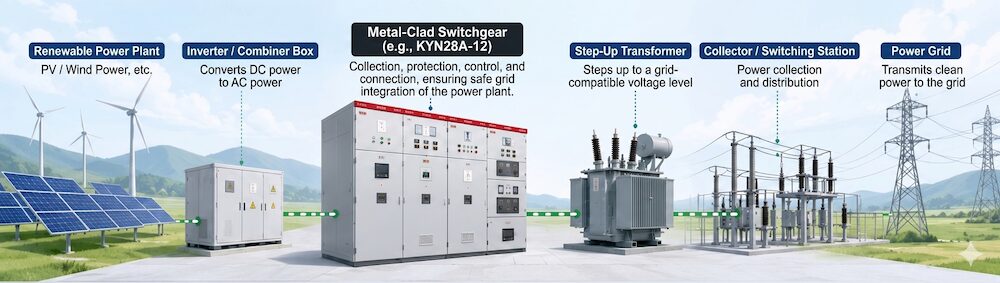
Electricity generated by PV arrays and wind turbines is highly dependent on meteorological conditions, making it intermittent by nature. Furthermore, initial voltage levels are typically low (ranging from 400V to 800V). To facilitate long-distance transmission and minimize line losses, the system must step up this voltage to medium-voltage levels (such as 12kV, 24kV, or 40.5kV) via transformers. At this critical step-up node, medium-voltage switchgear serves as more than just a conduit; it is a vital barrier ensuring the balance of power quality between the generating assets and the main utility grid. Maintaining precise synchronization and safety in a rapidly changing generation environment remains a core technical hurdle for modern energy systems.
2. Why Choose Metal-Clad Switchgear?
Medium voltage metal-clad switchgear (typically referring to air-insulated switchgear complying with IEC standards, such as the KYN28 series) has become the preferred choice for MV distribution due to its architectural emphasis on safety and operational efficiency.
- Advanced Compartmentalization: In a metal-clad architecture, the vacuum circuit breaker, busbars, cables, and instrument compartments are completely isolated from each other by grounded metal partitions. This design limits potential faults to a single compartment, preventing a “domino effect” in the event of an internal arc fault and maximizing the safety of personnel and adjacent equipment.
- Withdrawable (Draw-out) Design: To meet the high-availability demands of renewable projects, withdrawable circuit breakers allow maintenance teams to inspect or replace core components within minutes. In PV or wind farms, this modularity significantly reduces unscheduled downtime and directly improves the long-term operational efficiency of the station.
- Comprehensive Mechanical Interlocking: To eliminate the risk of human error, metal-clad switchgear is equipped with mandatory interlocking mechanism. These systems enforce a strict logical sequence for all operations—for instance, preventing the breaker carriage from being moved unless the breaker is open, or ensuring the cable compartment door remains locked until the earthing switch is in the safe position. This physical logic provides the most critical line of defense for onsite personnel.
- Optimized Economic Viability: While ensuring high standards of short-circuit breaking capacity and protection, metal-clad switchgear strikes an ideal balance between initial CAPEX and long-term OPEX. Compared to expensive high-voltage gas insulated switchgear, it offers a highly competitive cost-to-performance ratio for MV interconnection projects, optimizing the Return on Investment (ROI) while maintaining full grid compliance.


3. Key Protection and Monitoring Tasks in Integration Systems
Within complex renewable integration architectures, metal-clad switchgear performs multiple roles to ensure controlled power flow:
- Transient Protection and Fault Isolation: When short circuits, overloads, or transient overvoltages occur—either on the inverter side or the utility grid—the vacuum circuit breakers within the switchgear respond within milliseconds. This precision prevents fault surges from damaging expensive assets such as main transformers.
- Real-time Monitoring and Quality Management: Integrated Potential Transformer (PT) units capture grid voltage fluctuations, frequency, and phase parameters in real time. This high-precision data feedback is essential for ensuring that the electricity produced by distributed energy resources remains perfectly synchronized with the utility grid frequency.
- Coordinated Anti-Islanding Logic: Through linkage with relay protection systems, the switchgear ensures immediate disconnection if the external grid loses voltage. This is not only a regulatory requirement but also a vital safety measure to protect utility personnel working on the lines during an outage.
4. Application and Adaptability in Diverse Environments
As the scale and environmental complexity of renewable projects grow, metal-clad switchgear demonstrates remarkable flexibility.
- C&I and Utility-Scale Power Plants: For 12kV to 40.5kV grid-connection schemes, metal-clad switchgear is globally recognized as the standard solution. It provides sufficient short-circuit breaking capacity while offering the cost-effectiveness and ease of maintenance required for commercial, industrial, and ground-mounted PV projects.
- Extreme Environment Resilience: In high-altitude, desert, or coastal regions, modern metal-clad units are optimized through enhanced air insulation designs or insulation margin corrections based on altitude. When combined with reinforced Ingress Protection (IP) ratings, these units effectively resist extreme temperature swings, sand abrasion, and salt spray corrosion, ensuring long-term reliability in harsh climates.
5. MV Switchgear: Providing a Robust Guarantee for the Green Energy Transition
Achieving efficient grid integration depends largely on the stability of the distribution system within volatile environments. Metal-clad switchgear, with its robust compartmentalization, operational flexibility, and precise protection capabilities, has become an indispensable foundation of modern green power architecture. Choosing equipment that meets international standards and is proven in harsh environments not only ensures compliance but also provides long-term security for the entire lifecycle of global energy transition projects.
As one of the leading medium voltage switchgear manufacturers, Liyond is committed to delivering high-quality MV switchgear for renewable energy projects worldwide. We supply a wide range of high-performance metal-clad switchgear, including the KYN28 series, and provide professional customized design services tailored to specific application challenges—such as extreme environmental conditions or specialized grid-connection logic. Furthermore, Liyond offers a comprehensive range of core switchgear components and accessories, aiming to provide customers with one-stop support from complete systems to maintenance spares. For professional technical support or customized distribution solutions, please contact our expert team today.
Get A Free Quote


Power your projects with long-lasting switchgear and switchgear components from Liyond.
