

 EN
EN RU
RU

 Home/Blogs/Industry Knowledge/Vacuum Circuit Breaker Daily Inspection: A Guide to Performance Optimization
 July 02, 2025
Vacuum circuit breakers (VCBs) are crucial protection and control devices in power systems, and their stable and reliable operation directly impacts the safety and efficiency of power supply. To ensure your VCBs remain in optimal working condition and maximize their service life, regular daily inspections are essential. This article provides a practical inspection guide to help operators promptly identify potential issues and ensure efficient, stable equipment operation.
I. Key Daily Inspection Points for Vacuum Circuit Breakers
During the normal operation of vacuum circuit breakers, it is recommended to perform the following regular checks to ensure they remain in good condition. This section outlines crucial inspections for various parts of vacuum circuit breaker.
Closed Position Check:
The VCB operating mechanism should be accurately in the closed position, with clear indications.
The circuit breaker’s main shaft roller should be disengaged from the oil damper.
The opening spring should be in its charged/tensioned state, conforming to design requirements.
The exposed length of the vacuum interrupter’s moving contact rod should be within the normal design range, without anomalies.
(For glass or ceramic tube type interrupters) The bellows appearance should remain normal, without visible deformation or damage.
Temperature indicating strips on the VCB’s upper and lower supports should show no abnormal color changes, indicating normal connection point temperatures.
Conductive Connection Part Check:
Check the bolts connecting the upper and lower supports to external connections, ensuring they are not loose.
Ensure the bolts securing the vacuum interrupter to the upper support are tight.
Check that the bolts on the lower support’s conductive clamps are not loose.
All conductive contact surfaces should be clean, free from signs of overheating, discoloration, or corrosion.
Mechanical Transmission Component Check:
Check the bearings and end stops between the crank arm and the interrupter’s moving end rod, ensuring they are securely connected and free from abnormal play.
Ensure the fixing nuts and lock nuts of the pull rod and crank arm are reliably tightened, without loosening.
Ensure the bolts securing the post insulators (e.g., to the circuit breaker frame) are tight.
Check that the VCB’s mounting bolts show no signs of loosening.
Ensure the connecting nuts and lock nuts between the mechanism’s main shaft and the VCB’s crank arm are reliably tightened.
Inspect the welded parts of the transmission connecting rod for any visible cracks, deformation, or breakage.
Check that the main drive shaft’s pins are not loose or dislodged.
Safety Tip: To prevent accidental damage to the vacuum interrupter or other components, strictly avoid placing any items on the vacuum circuit breaker.

II. Identifying Abnormalities and Preliminary Judgment for Vacuum Circuit Breakers
In routine inspections, if any of the following abnormal phenomena are observed, immediate attention and preliminary judgment should be made:
Abnormal Appearance of Vacuum Interrupter:
If the vacuum interrupter (e.g., glass or ceramic tube casing) shows physical damage such as cracks or breakage during inspection, it should immediately be considered a serious anomaly, even if it has not yet caused a system ground fault or short circuit.
Check the vacuum interrupter’s ends and welded surfaces connecting to external components for any obvious displacement, deformation, or signs of detachment.
Preliminary Judgment of Abnormal Vacuum Degree:
Arc Color Observation: During circuit breaker opening operations, if the arc color, normally a faint blue, is observed to change to a distinct orange-red, this may be a direct visual indication of reduced vacuum.
Mechanical Self-Closing Force Test: Under safe conditions, disconnect the connecting pin between the pull rod and the crank arm, then manually pull the contact rod. Observe whether the contact rod can automatically return and remain in the closed position (due to external atmospheric pressure). If the self-closing force of the contact rod is notably weak or it fails to return automatically, it strongly suggests a significant reduction in the vacuum interrupter’s internal vacuum. Definitive confirmation often requires a specific VCB test for vacuum integrity, conducted by qualified personnel.
Common Causes of Vacuum Reduction: Reasons for reduced vacuum may include poor airtightness of interrupter materials, issues with bellows seal quality, or improper stroke settings during commissioning that exceed the bellows’ design range – aspects that a reputable vacuum circuit breaker manufacturer rigorously controls.
III. Common Faults and Troubleshooting for Vacuum Circuit Breakers
Below are some common fault phenomena affecting the operation of vacuum circuit breaker and their preliminary troubleshooting approaches:
Electric Operation Fails to Close:
Symptom: After a closing command is issued, the circuit breaker mechanism does not operate or fails to fully close.
Preliminary Troubleshooting: Check if the connection between the iron core and the pull rod inside the operating mechanism is loose or jammed. Simultaneously, confirm that the operating mechanism’s energy storage status is normal.
Closing Operation is Empty/Ineffective:
Symptom: Although the closing operating mechanism moves, the circuit breaker’s main contacts fail to close, or close insecurely.
Preliminary Troubleshooting: Check the engagement distance between the latching components (e.g., pawl) and the roller inside the operating mechanism, to confirm if it is insufficient or fails to pass the dead center.
Electric Operation Fails to Trip/Open:
Symptom: The circuit breaker cannot be opened (tripped) via electric operation.
Preliminary Troubleshooting: Check the engagement status of the tripping mechanism, determining if the latching component (e.g., pawl) is engaged too deeply. Also, inspect the tripping coil’s connecting wires for looseness or breakage. Furthermore, confirm that the operating voltage is within the normal design range.
Closing/Tripping Coil Burnout:
Symptom: Damage of circuit breaker coil leads to the failure of the corresponding closing or tripping function.
Preliminary Troubleshooting: Check the contact condition of the auxiliary switch; poor contact can cause the coil to remain energized for too long, leading to overheating and burnout.
IV. Vacuum Circuit Breakers: Professional Support and Safe Operation
Routine operational inspections are a critical aspect of ensuring the long-term, reliable, and efficient performance of vacuum circuit breakers. They help in early detection of potential issues and enable proactive measures, thereby preventing unplanned downtime. Liyond Vacuum Circuit Breakers are renowned for their exceptional quality, high reliability, and extremely low maintenance requirements. Regular inspections aim to further extend their service life and ensure their optimal performance within the power system.
If you are interested in Liyond’s high-quality medium and high voltage switchgear and accessory products, or require any related professional technical consultation and product solutions, please feel free to contact our expert team. Liyond is committed to providing you with excellent products, including custom switchgear, and tailored solutions.
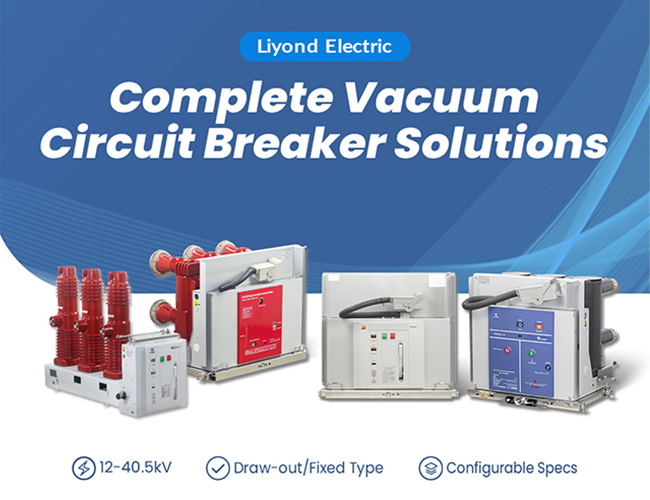
Brief reading: The Importance of Regular Vacuum Circuit Breaker Inspection
Please note: While this guide provides detailed inspection points and preliminary judgment methods, any work involving the internal structure of the circuit breaker, complex parameter measurement, precise adjustment, or repair work must be performed by qualified and experienced electrical technical personnel. Improper operation performed independently may result in equipment damage or jeopardize personal safety.
Get A Free Quote


Power your projects with long-lasting switchgear and switchgear components from Liyond.
