

 EN
EN RU
RU


April 28, 2026
In medium and high-voltage distribution systems, the reliability of Vacuum Circuit Breakers (VCBs) is the cornerstone of stable grid operation. As the primary power source for opening and closing operations, the design precision and manufacturing quality of the spring operating mechanism directly determine the breaker’s kinematic performance and mechanical lifespan. A deep understanding of the underlying design—spanning energy storage, mechanical interlocking, and anti-pumping logic—is essential for ensuring the operational safety and efficiency of MV/HV power systems.
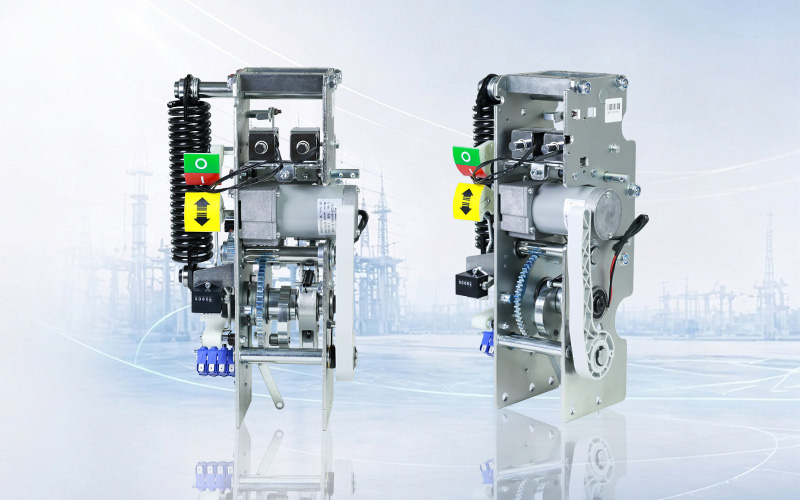
I. High-Intensity Energy Storage and Stable Release: Ensuring Precision Auto-reclosing
In the VCB operating mechanism, the storage spring acts as the core power source, ensuring that the contacts of the vacuum interrupter complete precise displacement within milliseconds. The mechanism is designed with a pre-stored energy buffer capable of supporting multiple consecutive operations, enabling the breaker to reliably execute the “Open – 0.3s – Close-Open (O-0.3s-CO)” auto-reclosing sequence.
This places rigorous demands on the high-strength performance and fatigue life of the spring materials. Furthermore, the energy release curve must remain highly stable over long-term operation to ensure that the speed, travel distance, and impact torque of every operation strictly comply with technical standards. In real-world distribution scenarios, the comprehensive performance of the operating mechanism is particularly critical during auto-reclosing:
- Rapid Response and Precise Timing: When a transient fault occurs, a VCB with rapid auto-reclosing capabilities must instantly open to clear the fault current and subsequently reclose within a tight 0.3-second interval to restore power.
- Sustained Reliability: Should the fault persist, the mechanism must support an immediate second opening operation.
This high-frequency, high-intensity operational sequence demands exceptional mechanical stability and electrical coordination. Achieving this level of performance is of core value to users aiming to minimize downtime and restore power swiftly.
II. Mechanical Interlocking: Rigid Physical Constraints and Safety Barriers
As the fundamental means of ensuring standard safety interlocking functions, mechanical interlocks solidify operational logic within the mechanism through physical intervention. The core principle follows the “Locked when Closed, Inhibited when Displaced” rule:
- Locked when Closed: When the VCB is in the closed position, the interlocking mechanism physically locks the movement path of the chassis (truck), preventing it from being withdrawn while under load—thus avoiding catastrophic arcing accidents.
- Inhibited when Displaced: If the chassis is not correctly locked in its designated test or work position, the closing operation is physically blocked at the mechanical level, preventing potential equipment damage caused by loose contact arcing.
Mechanical interlocks do not rely on electrical signals, external power, or human judgment; they provide rigid constraints directly through the physical structure. These geometry-based forced interlocks form the most robust safety barrier in the VCB architecture, ensuring that safety protocols are strictly enforced under any extreme operating conditions.
III. Double Anti-Pumping Mechanism: Suppressing Command Conflicts and Oscillation Risks
To prevent “hunting” or “pumping”—a dangerous and continuous “Close-Open” oscillation caused by conflicting control signals or permanent system faults—spring operating mechanisms are equipped with dual anti-pumping functions. Such abnormal oscillations lead to frequent contact impacts, which can rapidly destroy the vacuum interrupter and cause severe equipment failure.
This function employs a synergistic strategy combining an electrical anti-pumping circuit with a mechanical anti-pumping device, creating a redundant and complementary safety logic:
- Electrical Level: Intervention is managed via anti-pumping relays within the control circuit.
- Mechanical Level: Physical interlocking is achieved through a gear-and-latch mechanism.
When a continuous or abnormal closing command is detected, the mechanical system physically interrupts the power transmission chain, ensuring the breaker remains reliably in the open position after one operation. This dual defense ensures high operational certainty and stability even under erratic control conditions.
IV. Spring Operating Mechanism Applied in Vacuum Circuit Breakers
The spring operating mechanism is the most critical power compensation and execution unit of an MV VCB, directly affecting the response speed during fault clearing and the overall service life. Currently, mainstream VCB series such as VS1, VSG, and VBI utilize spring operating mechanisms as their standard configuration.


The widespread adoption of this technology stems from its significant technical advantages: it provides stable opening/closing torque to ensure synchronous contact movement, offers high modularity for environmental adaptability, and simplifies maintenance. Based on this core platform, different series offer distinct features:
- VSG and VBI Series: These are optimized for high-reliability and high-frequency operation. Through fatigue-resistant spring materials and precision cam-direct-drive technology, they can achieve a mechanical life of up to 50,000 operations. For 35kV high-voltage requirements, the VSG series can be equipped with a dual-spring structure to provide greater breaking energy reserves and dynamic stability.
- VS1 Series: As the most versatile representative in the industry, the VS1 series ensures precise mechanism action while offering excellent dimensional compatibility with various standard switchgear panels, making it an ideal choice for standardized power distribution.
- System Integration Flexibility: Due to their structural advantages, these models integrate seamlessly with high-precision chassis modules. This modular approach ensures operational flexibility while guaranteeing that safety interlocking logic remains absolutely reliable in practice.
V. Conclusion
In summary, the stable operation of vacuum circuit breakers relies on the systematic synergy of energy storage, physical constraints, and redundant protection. As the core power unit, the spring operating mechanism integrates technical value across multiple dimensions: ensuring auto-reclosing characteristics through optimized energy curves, building a physical defense independent of external power via mechanical interlocks, and guaranteeing command execution integrity through dual anti-pumping designs.
As a dedicated vacuum circuit breaker manufacturer, Liyond is committed to translating these underlying mechanical logics into reliable product performance. Leveraging high-quality delivery and rigorous quality control for the VS1, VSG, and VBI series, we provide not only industry-standard high-performance VCBs and operating mechanisms but also a comprehensive range of components and integrated solutions. Moving forward, Liyond will continue to leverage its technical expertise and innovation to support the safety, reliability, and efficiency of global power systems.
Get A Free Quote


Power your projects with long-lasting switchgear and switchgear components from Liyond.
