

 EN
EN RU
RU

 Home/Blogs/Industry Knowledge/High-Frequency Switching Solutions: Why Vacuum Contactors are Ideal for MV Systems
 April 27, 2026
In medium-voltage power distribution systems, balancing equipment operating frequency with service life is a persistent challenge. Consequently, selecting between vacuum contactors and vacuum circuit breakers based on specific application requirements is a critical factor in industrial electrical design. While VCBs excel in short-circuit protection, vacuum contactors have become the preferred choice for ensuring system stability in specialized applications requiring high-frequency operations, such as frequent motor starting/stopping and capacitor bank switching, thanks to their superior switching capacity and exceptionally long mechanical life.
Core Performance of Vacuum Contactors: Mechanical Life and Environmental Adaptability
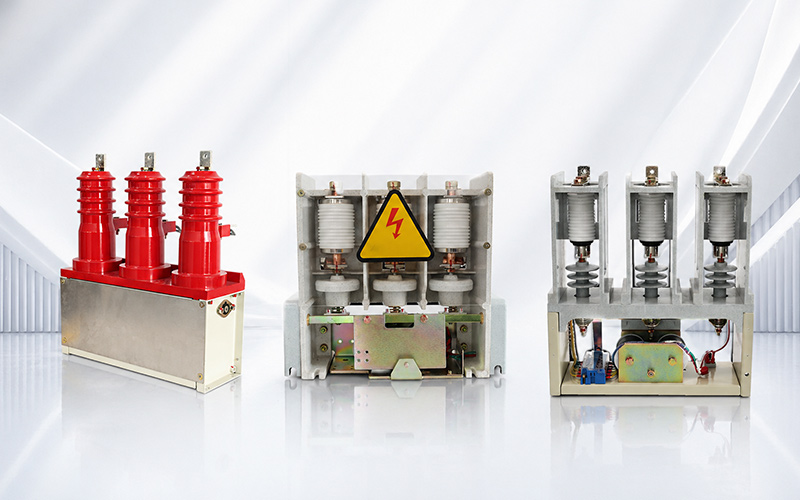
A vacuum contactor is a device specifically designed to close, carry, and interrupt normal operating currents as well as specified overload currents. Compared to circuit breakers, its primary advantage lies in its extreme adaptability to high-frequency operations. The mechanical life of a medium-voltage vacuum contactor can typically reach hundreds of thousands or even millions of cycles, enabling it to withstand intensive switching operations of up to several hundred times per hour.
More about: vacuum contactor vs circuit breaker
This exceptional performance is largely attributed to its core component—the vacuum interrupter. Since the contact gap inside the interrupter is very small (typically only a few millimeters), the travel distance during opening and closing is much shorter than that of other types of switching equipment. This significantly reduces the impact energy during operation and physically minimizes mechanical wear, providing the foundation for high durability.

Vacuum contactors demonstrate outstanding environmental adaptability in high-intensity operational settings. Because the interrupter is completely sealed in a vacuum, the contacts are unaffected by the external atmospheric environment. This means that even in high-altitude regions (where dielectric strength does not decrease), humid environments (where contacts do not rust or oxidize), or chemical plants with corrosive gases, the equipment maintains consistent arc-quenching performance and electrical insulation strength. These characteristics provide a solid technical guarantee for continuous production processes in industries such as mining, metallurgy, and petrochemistry.
The following table compares the performance of several popular Liyond indoor vacuum contactor series and provides typical application recommendations:
| Product Series | Mechanical Life | Typical Applications |
| CKG3 Series | 500,000 – 1,000,000 cycles | Widely used for frequent motor start/stop control in metallurgy, petrochemistry, and industrial pump stations. |
| CKG4 Series | 500,000 – 1,000,000 cycles | Capacitor bank switching in substations, reactive power compensation devices, and frequent transformer switching. |
| JCZ5 Series | 300,000 cycles | Medium-voltage motor starting control and general power distribution system protection under standard conditions. |
Electromagnetic Operating Mechanism: The Principle Behind Long-Term Mechanical Durability
The ability of vacuum contactors to handle high-frequency switching tasks stems from the fundamental physical differences between their electromagnetic operating mechanisms and the traditional spring-charged mechanisms used in VCBs:
- Significant Reduction in Mechanical Impact: The electromagnetic mechanism operates via magnetic attraction with very few components. Compared to complex spring mechanisms, mechanical stress is drastically reduced. This direct-drive architecture effectively avoids metal fatigue and serves as the technical cornerstone for achieving million-cycle mechanical life.
- High Consistency in Operating Response: Electromagnetic mechanisms provide extremely fast response times and constant contact pressure. This consistency not only suppresses additional arc energy caused by operational delays but also significantly reduces electrical wear on the contacts. This ensures that the equipment maintains excellent current-carrying performance even after high-frequency switching, achieving synergistic optimization of mechanical and electrical performance.
- Low Noise and Micro-Vibration Characteristics: Thanks to the simplified kinematic chain, the vibration during operation is minimal. This not only reduces operating noise but also minimizes mechanical shock to precision electronic components within the switchgear cabinet, enhancing the system-level reliability of the entire assembly.
- Near “Zero-Maintenance” Cost Advantage: Due to the simplified structure and minimal moving parts, the electromagnetic mechanism requires almost no complex lubrication or calibration during long-term operation, greatly reducing post-maintenance investment in frequent operation scenarios.
Technical Developments in Medium-Voltage Vacuum Contactors
As industrial applications move toward higher power, digitalization, and extreme environments, medium-voltage vacuum contactors are evolving from basic switching components into high-performance technical terminals. The following core technological developments have become key standards for measuring the next generation of high-performance vacuum contactors:
Evolution of Embedded Poles Technology
To address extreme environments such as high humidity, heavy dust, and chemical corrosion, embedded poles technology is increasingly being adopted in high-end applications. By encapsulating the vacuum interrupter directly within high-performance epoxy resin insulation material, the embedded pole achieves a superior level of protection. This completely isolates the impact of external pollutants on insulation performance, ensuring long-term stability under harsh conditions.
Taking Liyond’s CKG4-10FC as an example, this model utilizes advanced embedding processes, which not only significantly enhance the insulation reliability of the primary circuit but also enable a more compact design, effectively reducing phase-to-phase distance requirements. This design thoroughly eliminates insulation risks caused by surface tracking and environmental pollution, making it an ideal choice for demanding industrial sites such as explosion-proof mines, cement plants, and coastal salt spray environments.
Continuous Optimization of Current-Carrying and Interrupting Capacities
In response to increasing load capacities, high-performance contactors are designed toward rated currents of 630A and above. By optimizing contact material compositions and the internal flow field design of the interrupter, new equipment maintains high-frequency switching characteristics while gaining larger margins for short-circuit overload endurance, effectively solving thermal challenges during large-capacity load switching.
Digitalization Development Trends
Digitalization is a core trend in the development of smart grids. As a critical component of medium voltage switchgear, vacuum contactors are aligning with this trend. In the future, there will likely be further developments in technologies and products related to the intelligent monitoring of vacuum contactors. By integrating sensors to monitor primary circuit temperature, mechanical travel, and secondary circuit status in real-time, maintenance models are shifting from traditional “scheduled maintenance” to more advanced “predictive maintenance.” This digital transformation can effectively reduce unplanned downtime, enhance system safety, and align with the sustainability goals of industrial facilities.
Conclusion
The core value of medium-voltage vacuum contactors lies in their exceptional stability under high-frequency operating conditions. By achieving million-cycle mechanical life through electromagnetic operating mechanisms and providing environmental adaptability via vacuum interrupters and embedded poles technology, these devices effectively solve the durability challenges of medium-voltage distribution systems under frequent switching tasks.

As power system requirements for reliability and intelligence continue to rise, vacuum contactors are not only undergoing continuous optimization in mechanical architecture to reduce maintenance needs but are also achieving deep synergy between mechanical life and electrical performance through advancements in material science and monitoring technology. For industrial users, selecting a technically mature and structurally reliable vacuum contactor solution is key to ensuring production continuity and reducing total lifecycle operating costs. Liyond will continue to advance vacuum contactor technology, aiming for the ultimate synergy between mechanical and electrical performance to help global customers build a more stable, low-carbon, and intelligent power distribution future in heavy-duty and high-frequency applications.
Get A Free Quote


Power your projects with long-lasting switchgear and switchgear components from Liyond.
