

 EN
EN RU
RU

 Home/Blogs/Industry Knowledge/Switchgear Internal Integrity Under Climatic Stress: Insulation Accessories and Electrical Performance
 June 03, 2026
Against the backdrop of increasing global climate variability, the frequency of extreme weather events—such as typhoons, heavy rainfall, and sudden, drastic temperature fluctuations—has risen significantly. These environmental shifts have imposed more stringent requirements on the operational reliability and system resilience of modern power distribution networks.
Currently, most strategies for upgrading grid resilience focus on macro-level microgrid dispatching or reinforcing external overhead lines. However, for medium-voltage distribution systems, critical risks often lie within the switchgear itself. While the metal enclosure of a switchgear cabinet can withstand direct physical impact, the internal micro-environment remains vulnerable to climatic stress when humidity and temperature reach extreme limits.
As the central energy hub of the distribution network, the switchgear’s security directly determines the continuity of power delivery. When climatic stress penetrates the outer barrier, key switchgear components—such as contact boxes, bushings, insulation cylinders, and tulip contacts—become the primary line of defense in maintaining internal electrical stability and integrity. They are not merely physical barriers against internal surface flashover and abnormal overheating, but are the core carriers that keep the grid running uninterrupted during extreme weather. By upgrading the materials and structural design of these microscopic key nodes, transitioning from traditional passive insulation to a micro-level immune system with deep, adaptive defense capabilities is a necessary choice for solidifying the foundation of grid resilience.

Switchgear Insulation Accessories Manufacturing and Moisture Resistance
In climates characterized by prolonged rainy seasons or high relative humidity, insulation components inside medium-voltage switchgear—such as contact boxes, bushings, and insulation cylinders—endure persistent moisture penetration pressure. If conventional insulation materials lack sufficient internal density, they are prone to absorbing trace amounts of moisture, leading to a decline in dielectric strength and insulation resistance, which can trigger internal insulation breakdown.
To ensure long-term dielectric stability under persistent high-humidity conditions, manufacturers must strictly control two key production stages:
1. Environmental Adaptation Optimization in Raw Material Mixing and Degassing
In foundational manufacturing, the precise proportioning of raw materials and vacuum degassing are the underlying steps that determine moisture resistance. When liquid epoxy resin is mixed with hardeners, modified fillers (such as high-purity silica powder) are typically added to enhance mechanical and electrical properties.
If microscopic bubbles within the resin are not completely removed during the vacuum degassing stage, these trapped bubbles will gradually absorb moisture permeated through molecular diffusion when exposed to high relative humidity. Under the high electric field of medium-voltage systems, these moisture-absorbing microscopic air gaps are the first to experience partial discharge. Therefore, by implementing rigorous vacuum degassing to ensure the partial discharge level of the finished product is kept to an absolute minimum, we can physically eliminate the space required for moisture to trigger internal insulation breakdown.
2. Density Enhancement in Gelation and Curing (Application of the APG Process)
During the casting and curing stages, to address stresses caused by high-humidity environments, manufacturers typically employ the Automatic Pressure Gelation (APG) process. Unlike traditional atmospheric pressure curing, the APG process allows the epoxy resin to cure rapidly under constant, high pressure within the mold.
This high pressure perfectly compensates for the volume shrinkage that occurs during the chemical cross-linking of the resin. Molecular curing achieved under pressure ensures the internal structure of the final solid insulator is free of voids, possessing high microscopic consistency and high density. This high density results in extremely low water absorption, ensuring that the dielectric constant and insulation resistance remain stable even when the equipment is exposed to rainy or high-humidity environments for long periods.
Optimizing Geometric Design to Prevent Surface Flashover
According to medium-voltage distribution system specifications, there are strict standards for the surface creepage distance ratio of organic insulation components to prevent surface flashover. However, in actual operating environments with variable climates, meeting static length requirements alone is insufficient.
Condensation caused by sudden temperature differences inside the switchgear cabinet is a direct trigger for surface flashover. When a large number of tiny water droplets aggregate and merge on smooth insulation surfaces, they form a continuous conductive water film. This water film drastically compresses the air insulation margin, causing leakage current to expand along the surface of the insulation.
The ribbed (or corrugated/umbrella skirt) structural design has become the industry-standard solution to this risk without increasing the overall volume of the switchgear. However, in actual production, this complex geometric contour presents significant challenges for epoxy injection molding. Due to geometric discontinuities, stress concentration and micro-pores are easily generated at the base of the ribs during curing and shrinkage, which remains a technical bottleneck for many conventional manufacturers.


These protruding rib structures provide critical physical protection mechanisms:
- Path Extension in Space-Constrained Environments: The ribbed design utilizes wave-like fluctuations to maximize the actual surface creepage distance within the extremely limited internal space of the switchgear.
- Physical Interruption of Conductive Water Film Pathways: The ribbed structure leverages gravity and inclination angles to physically break the continuous water film formed by condensation. Once the water film is interrupted by the ribs, it cannot form a large-area path, thereby forcing surface leakage current to be suppressed within safe limits.
To ensure that these ribs do not age or crack when facing extreme climates (such as frequent thermal expansion and contraction due to drastic temperature changes), we implement strict control over mold flow design and temperature profiles during manufacturing. This precision craftsmanship ensures the molecular structure at the base of the ribs is dense and free of residual stress. Combined with the resin material’s inherent anti-tracking capability (i.e., high Comparative Tracking Index, CTI), this ensures that even if limit-level condensation occurs, the insulation surface will not form carbonized conductive paths, fundamentally eliminating the risk of surface flashover. This is the core technical watershed between premium components and conventional ones.
Tulip Contacts and Thermal Accumulation Mitigation
When external distribution networks operate under extreme high-temperature and heavy-load conditions, heat accumulation often occurs at the connection points of circuit breaker contacts inside the switchgear. Under persistent high current and harsh environmental stress, long-term thermal fatigue leads to electrochemical corrosion and accelerated oxidation of the metal contact surfaces.
Copper contacts form copper oxide layers after heating, leading to increased contact resistance. According to heat effect laws, an increase in resistance generates more localized heat, triggering a vicious cycle of “resistance increase – abnormal temperature rise – accelerated oxidation.” Without control, this inevitably leads to contact burnout, phase-to-phase short circuits, and other severe failures.
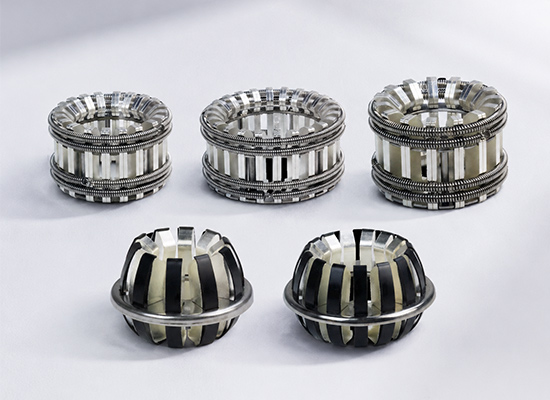
To completely dismantle this risk, high-performance tulip contacts must be controlled to high standards during manufacturing and structural design:
1. High-Conductivity Thick Silver Plating Process
The surfaces of tulip contact segments require high-standard thick silver plating. Silver’s extremely high electrical conductivity significantly reduces initial contact resistance, minimizing self-heating during operation. More importantly, silver’s physical and chemical properties are more stable than copper’s, effectively isolating air and moisture under high-humidity and high-temperature conditions, thus terminating the vicious cycle of accelerated oxidation of the copper substrate at the material source.
2. Constant Mechanical Pressure from Stainless Steel Springs
Beyond surface material improvements, the fastening and clamping design of tulip contacts is equally crucial for maintaining electrical continuity. High-quality tulip contacts are equipped with dedicated stainless steel tension springs. These springs possess excellent resistance to thermal decay, providing constant and uniform high mechanical pressure for every contact segment, even during sustained high-load temperature rises, ensuring the contacts remain tightly mated and keeping contact resistance at a very low level.
3. Self-Cleaning Friction Effect
During the mechanical movement of the switchgear—such as switching operations or the insertion/withdrawal of the handcart—the high mechanical pressure provided by the springs creates friction between the contact segments and the stationary contact. This friction automatically scrapes off any microscopic oxide layers or light condensation that may remain on the metal surface, ensuring the electrical contact surface is always clean and reliably conductive.
Core Technical Specifications of Switchgear Insulation and Contact Components
To help power distribution network engineers and procurement managers evaluate the ability of switchgear components to cope with extreme climates, manufacturers recommend using the following core electrical and physical parameters as key verification metrics during the procurement stage:
| Core Component Category | Key Technical Metrics | Resilience Value |
| Solid Insulation Components (Contact boxes, bushings, insulation cylinders) | Low Partial Discharge: Show extremely low partial discharge levels at rated voltage. | Verifies the microscopic density of the vacuum degassing and curing process. Proves no micro-voids exist within the material, preventing moisture penetration under high humidity from triggering internal partial discharge and insulation breakdown. |
| High Comparative Tracking Index (CTI): Uses materials that meet high international standards. | Verifies the epoxy resin’s resistance to carbonization and tracking. Ensures the material surface is not prone to forming carbonized conductive paths even if surface condensation occurs due to drastic temperature fluctuations. | |
| Geometric Design Optimization: Features a mature ribbed structure. | Utilizes 3D geometry to maximize creepage distance in limited space, and uses physical inclination to interrupt continuous conductive water films, fundamentally preventing surface flashover. | |
| Electrical Contact Components (Tulip contacts and contact systems) | Premium Silver Plating Thickness: Provides thick silver plating suitable for various salt spray or heavy-load conditions. | Uses a high-thickness, high-conductivity silver layer to physically isolate moisture and air, terminating accelerated oxidation caused by heat in the copper substrate and breaking the cycle of contact heating. |
| Ultra-Low Contact Resistance & Spring Stability: Maintains ultra-low contact resistance under heavy-load operation. | Pairs with high-quality, fatigue-resistant stainless steel tension springs to ensure contacts remain tightly mated. Uses the self-cleaning effect of friction during switching operations to scrape off surface oxides. |
Conclusion
The medium-voltage switchgear, as a core node of the power distribution network, has internal integrity and electrical performance that directly relate to the stable operation of the entire system. The insulation consistency of contact boxes, the physical interruption capability of bushing ribs, and the anti-oxidation thick silver plating of tulip contacts—these technical controls at the microscopic level constitute the final line of defense for switchgear to withstand the stresses of harsh environments. The resilience of modern distribution networks against extreme climate events relies not only on macro-level planning and system-level dispatching, but critically on the quality assurance of the most basic, underlying components inside the physical equipment.
As a professional switchgear accessories manufacturer, we are committed to combining mature electrical manufacturing processes with rigorous factory inspection systems. By implementing strict quality standards in raw material selection and maintaining highly rigorous process controls throughout the manufacturing workflow, we translate microscopic precision into guaranteed long-term operational reliability. We are dedicated to providing high-resilience core components that solidify the microscopic foundation of power distribution systems against future climate challenges.
Get A Free Quote


Power your projects with long-lasting switchgear and switchgear components from Liyond.
