

 EN
EN RU
RU


July 08, 2025
A load break switch (LBS) is an electrical switching device positioned between a circuit breaker and a disconnector (isolator). It features a basic arc extinguishing capability, allowing it to reliably make and break rated load currents and certain overload currents (typically 3-4 times the rated current). However, an LBS cannot interrupt short-circuit currents; instead, its design must ensure it can safely withstand fault currents for a specified short-circuit duration without damage. The core components of an LBS typically include an arc extinguishing device, an operating mechanism, and an insulating support frame. Based on their operation, LBS can be categorized into manual and motorized (electric) operated types, catering to various automation requirements.
According to their application scenarios, LBS load break switch can be classified as general-purpose or special-purpose. General-purpose LBS are used for routine switching operations in power distribution systems, while special-purpose LBS are designed for specific or unique operating conditions.
Based on their rated voltage levels, LBS are primarily divided into low-voltage (LV) load break switches and medium and high-voltage (MV/HV) load break switches. During installation, vertical mounting is generally required, and all metallic components, including the switch frame, operating mechanism, cable sheath, and protective steel conduits, must be reliably earthed. Serial grounding is strictly prohibited to ensure safety.
Types of Load Break Switch
Load break switches are typically classified based on their rated voltage levels:
Low Voltage Load Break Switches
Low voltage LBS, sometimes referred to as switch-fuse units, are mainly used in AC power frequency circuits for infrequent manual making and breaking of loaded circuits. They can also be coordinated with fuses to provide overload and short-circuit protection for lines. In such combinations, the making and breaking of the circuit are performed by the switch blades, while overload and short-circuit protection are handled by the series-connected fuses.
For early small-capacity LV LBS, the contact opening and closing speed might have been dependent on the manual operating speed. However, larger capacity LV LBS commonly employ a spring-energy storage operating mechanism, ensuring the opening and closing speeds are independent of the handle’s operation speed, thus guaranteeing rapid make-and-break actions. These switches have a relatively simple structure and are usually equipped with reliable mechanical interlocks. For instance, the switch cannot be closed when the cover is open, and the cover cannot be opened when the switch is closed, greatly enhancing operational safety.
Medium and High Voltage Load Break Switches
Medium and high-voltage LBS are categorized primarily by their arc extinguishing medium and method:
Solid Gas-Producing Load Break Switches: These utilize the energy of the arc itself to decompose gas-producing materials within the arc chamber, generating gas to extinguish the arc. Their structure is relatively simple, typically suitable for voltage levels up to and including 35 kV.
Puffer Type Load Break Switches: These extinguish the arc by the action of compressed gas generated by a piston during the opening process. Their structure is also relatively simple, suitable for products up to and including 35 kV.
Compressed Air Load Break Switches: These use externally supplied compressed air as the arc extinguishing medium. While capable of interrupting larger currents, their structure is more complex, making them suitable for products rated 60 kV and above.
SF6 Gas Load Break Switches: These employ Sulfur Hexafluoride (SF6) gas for arc extinguishing and insulation. SF6 gas offers excellent arc extinguishing performance, enabling them to interrupt large currents and perform exceptionally well in interrupting capacitive currents. However, their structure is relatively complex, and they are suitable for products rated 35 kV and above.
Liyond offers high-quality SF6 load break switches, covering common rated voltage levels such as 12kV, 24kV, and 40.5kV. These are widely used in ring main units (RMUs) and switchgear within power distribution systems.


Oil-Immersed Load Break Switches: These utilize the arc’s own energy to vaporize and decompose the surrounding insulating oil, which then cools and extinguishes the arc. Their structure is relatively simple, but they are heavy and primarily suitable for outdoor applications up to and including 35 kV.
Vacuum Load Break Switches: These utilize a high vacuum as the arc extinguishing medium. Vacuum interruption offers advantages such as long electrical life and minimal maintenance, though their relative cost is higher. They are generally suitable for products up to and including 220 kV.
Liyond specializes in providing indoor type vacuum load break switches, with common voltage ratings including 12kV and 24kV. These products are widely employed in various indoor power distribution applications due to their reliability and long service life.
Air Load Break Switches: These utilize air as both the insulating and arc extinguishing medium. Air LBS have a relatively simple structure and are suitable for specific indoor application scenarios.
Liyond’s product line also includes various models of air load break switches, offering an economical and reliable choice for configurations of many medium voltage switchgear.

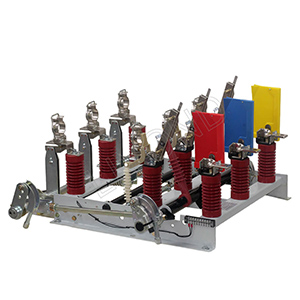

The working principles of medium and high-voltage LBS are similar to those of circuit breakers, but they typically feature simpler arc extinguishing devices and more compact structures. For instance, during a trip operation, the main and arc contacts open in a predetermined sequence through the action of a spring or operating mechanism, while the arc extinguishing medium (e.g., compressed air or SF6 gas) extinguishes the arc. The closing process is the reverse, with contacts closing in sequence.
Since load break switches inherently cannot interrupt short-circuit currents, they are commonly used in combination with current-limiting medium and high-voltage fuses. In this setup, the LBS handles the making and breaking of normal load currents and overcurrents up to a certain multiple, while the current-limiting fuse rapidly clears larger overcurrents and short-circuit faults. This effectively limits the peak short-circuit current, significantly reducing the thermal and electrodynamic stresses caused by fault currents, thereby providing comprehensive circuit protection.
Functions of Load Break Switches
As the name suggests, the primary function of a load break switch is to make and break load currents. Their specific application scenarios and functions include:
Making and Breaking Load Currents and Minor Overcurrents: LBS possess sufficient arc extinguishing capability to reliably perform circuit closing and opening operations, as well as handle overcurrents typically not exceeding 3-4 times the rated current.
Making and Breaking No-Load Transformers and Lines: Compared to disconnectors, LBS can safely make and break larger no-load transformers and longer no-load lines.
Making and Breaking Large Capacitor Banks: In certain situations, LBS can also be used to operate large capacitor banks.
Used in Series with Current-Limiting Fuses as a Circuit Breaker Alternative: When used in series with current-limiting fuses, the LBS handles normal load currents and minor overcurrents, while the current-limiting fuse takes on the task of interrupting larger overcurrents and short-circuit currents, collectively providing comprehensive protection.
Load Break Switch Operation and Maintenance Notes
Reliable Earthing: During installation, it is crucial to ensure vertical mounting. The switch frame, operating mechanism, cable sheath, and any protective steel conduits must be reliably earthed. It is particularly important that earthing connections are not made in series.
Operational Check: Before commissioning, the LBS should undergo several no-load opening and closing operations. This is to verify that all rotating parts move smoothly without jamming, that closing is fully engaged, and that there is sufficient safety clearance after opening.
Fuse Coordination: The fuse link used in series with the LBS must be appropriately selected. The key is to ensure that when a fault current exceeds the LBS’s breaking capacity, the fuse link melts first, protecting the LBS from damage.
In-Service Inspection and Maintenance: During closing, ensure good contact and that there are no overheating phenomena at connection points. During routine inspections, particular attention should be paid to checking porcelain insulators for dirt, cracks, chipping, or flashover discharge. Indoor type switches must not be washed directly with water.
Conclusion
Load break switches are indispensable electrical devices in power systems. Their unique positioning, bridging the functionality of circuit breakers and disconnectors, makes them crucial in power distribution networks. They not only safely and reliably make and break load currents and specific overcurrents but also, through effective coordination with fuses, provide comprehensive circuit protection against short-circuit faults. Compared to circuit breakers, LBS often offer advantages in terms of switching frequency and operational life. Whether it’s switch-fuse units in low-voltage applications or various arc-extinguishing medium types (such as SF6, vacuum, and air) in medium and high-voltage domains, LBS contribute significantly to ensuring the safe and stable operation of power systems with their relatively simple structure and efficient operating characteristics. A thorough understanding of their classification, working principles, main functions, and strict adherence to installation and operational guidelines is paramount for ensuring the long-term reliable performance of LBS, thereby safeguarding the entire power system.
As a specialized load break switch manufacturer, Liyond is committed to the research, development, and manufacturing of high-quality, high-performance LBS products. Leveraging our profound technical expertise and comprehensive product range, we are capable of providing custom switchgear solutions to meet your most stringent requirements. Whether you need specific arc-extinguishing media, voltage ratings, or manual/motorized operation options, Liyond is your reliable partner.
For more detailed product information, please explore our Load Break Switch product section on the website, or directly contact our professional team for tailored electrical solutions.
Get A Free Quote


Power your projects with long-lasting switchgear and switchgear components from Liyond.
